Equilbrium Constant and EXTERNAL EFFECTS
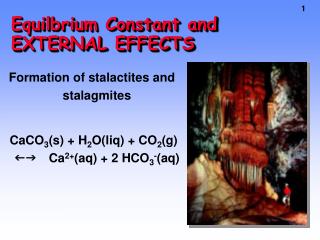
Explore the principles of chemical equilibrium, focusing on the formation of stalactites and stalagmites through the reaction of calcium carbonate (CaCO3) in the presence of water (H2O) and carbon dioxide (CO2). Learn how changes in temperature, pressure, and concentration affect equilibrium position, as described by Le Chatelier's Principle. This guide also discusses equilibrium constants and the impact of catalysts on reaction rates, along with practical examples of equilibria, including those in gaseous systems.

Equilbrium Constant and EXTERNAL EFFECTS
E N D
Presentation Transcript
Equilbrium Constant and EXTERNAL EFFECTS Formation of stalactites and stalagmites CaCO3(s) + H2O(liq) + CO2(g)fgCa2+(aq) + 2 HCO3-(aq)
EQUILIBRIUM • Temperature, catalysts, and changes in concentration/ pressure affect equilibria. • The outcome is governed by LE CHATELIER’S PRINCIPLE • “...if a system at equilibrium is disturbed, the system tends to shift its equilibrium position to counter the effect of the disturbance.”
Equilibrium constant and Concentration Concentration changes • no change in K • only the position of equilibrium changes.
Butane-Isobutane Equilibrium butane isobutane
butane ButaneIsobutane • At equilibrium with [iso] = 1.25 M and [butane] = 0.50 M. K = 2.5. • Add 1.50 M butane. • When the system comes to equilibrium again, what are [iso] and [butane]? isobutane
ButaneeIsobutane Solution Calculate Q immediately after adding more butane and compare with K. Q is LESS THAN K. Therefore, the reaction will shift to the ____________.
ButaneeIsobutane Q is less than K, shifts right toward isobutane. Set up ICE table [butane] [isobutane] Initial Change Equilibrium 0.50 + 1.50 1.25 - X + X 2.00 – x 1.25 + x
ButaneeIsobutane x = 1.07 M At the new equilibrium position, [butane] = 0.93 M and [isobutane] = 2.32 M. Equilibrium has shifted toward isobutane.
Equilibrium Constant and Catalyst • Add catalyst: NO change in K • A catalyst only affects the RATE it approach equilibrium. Catalytic exhaust system
Pressure and EquilibriumN2O4(g) e 2 NO2(g) Increase P in the system by reducing the volume (at constant Temp). e
N2O4(g) e 2 NO2(g) Increase P in the system by reducing the volume. In gaseous system the equilibrium will shift to the side with fewer molecules (in order to reduce the P). Therefore, reaction shifts LEFTand P of NO2 decreases and P of N2O4 increases.
Temperature Effects on Equilibrium Figure 16.6
Temperature Effects on Equilibrium N2O4 (colorless) + heat e 2 NO2 (brown) ∆Ho = + 57.2 kJ (endo) Kc (273 K) = 0.00077 Kc (298 K) = 0.0059
Every T has a unique K Temperature change = change in K Consider the fizz in a soft drink CO2(aq) + HEATe CO2(g) + H2O(l) K = P (CO2) / [CO2] • Increase T. What happens to equilibrium position? To value of K? • K increases as T goes up because P(CO2) increases and [CO2] decreases. • Decrease T. Now what? • Equilibrium shifts left and K decreases.
NH3 Production N2(g) + 3 H2(g) e 2 NH3(g) + heat K = 3.5 x 10⁸ at 298 K
Le Chatelier’s Principle • Change T -changes K • causes change in P or concentrations at equilibrium • Use a catalyst: K not changed. Reaction comes more quickly to equilibrium. • Add or take away reactant or product:K does not change Reaction adjusts to new equilibrium “position”
Examples of Chemical Equilibria Phase changes such as H2O(s) H2O(liq) e