A Streaming Processing Unit for a CELL Processor
A Streaming Processing Unit for a CELL Processor

A Streaming Processing Unit for a CELL Processor
E N D
Presentation Transcript
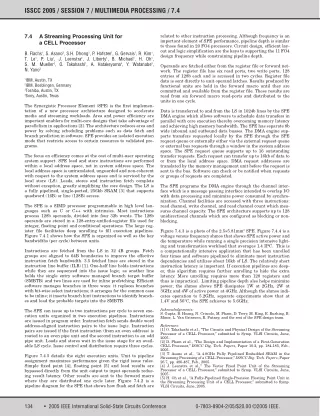
ISSCC 2005 / SESSION 7 / MULTIMEDIA PROCESSING / 7.4 related to other instruction processing. Although frequency is an important element of SPE performance, pipeline depth is similar to those found in 20 FO4 processors. Circuit design, efficient lay- out and logic simplification are the keys to supporting the 11 FO4 design frequency while constraining pipeline depth. 7.4 A Streaming Processing Unit for a CELL Processor B. Flachs1, S. Asano3, S.H. Dhong1, P. Hofstee1, G. Gervais1, R. Kim1, T. Le1, P. Liu1, J. Leenstra2, J. Liberty1, B. Michael1, H. Oh1, S. M. Mueller2, O. Takahashi1, A. Hatakeyama4, Y. Watanabe3, N. Yano3 Operands are fetched either from the register file or forward net- work. The register file has six read ports, two write ports, 128 entries of 128b each and is accessed in two cycles. Register file data is sent directly to unit operand latches. Results produced by functional units are held in the forward macro until they are committed and available from the register file. These results are read from six forward macro read-ports and distributed to the units in one cycle. 1IBM, Austin, TX 2IBM, Boeblingen, Germany 3Toshiba, Austin, TX 4Sony, Austin, Texas The Synergistic Processor Element (SPE) is the first implemen- tation of a new processor architecture designed to accelerate media and streaming workloads. Area and power efficiency are important enablers for multi-core designs that take advantage of parallelism in applications [2]. The architecture reduces area and power by solving scheduling problems such as data fetch and branch prediction in software. SPE provides an isolated execution mode that restricts access to certain resources to validated pro- grams. Data is transferred to and from the LS in 1024b lines by the SPE DMA engine which allows software to schedule data transfers in parallel with core execution thereby overcoming memory latency and achieving high memory bandwidth. The SPE has separate 8b wide inbound and outbound data busses. The DMA engine sup- ports transfers requested locally by the SPE through the SPE request queue or externally either via the external request queue or external bus requests through a window in the system address space. The SPE request queue supports up to 16 outstanding transfer requests. Each request can transfer up to 16kb of data to or from the local address space. DMA request addresses are translated by the memory management unit before the request is sent to the bus. Software can check or be notified when requests or groups of requests are completed. The focus on efficiency comes at the cost of multi-user operating system support. SPE load and store instructions are performed within a local address space, not in system address space. The local address space is untranslated, unguarded and non-coherent with respect to the system address space and is serviced by the local store (LS). Loads, stores and instruction fetch complete without exception, greatly simplifying the core design. The LS is a fully pipelined, single-ported, 256kb SRAM [3] that supports quadword (16B) or line (128B) access. The SPE programs the DMA engine through the channel inter- face which is a message passing interface intended to overlap I/O with data processing and minimize power consumed by synchro- nization. Channel facilities are accessed with three instructions: read channel, write channel, and read channel count which mea- sures channel capacity. The SPE architecture supports up to 128 unidirectional channels which are configured as blocking or non- blocking. The SPE is a SIMD processor programmable in high level lan- guages such as C or C++ with intrinsics. Most instructions process 128b operands, divided into four 32b words. The 128b operands are stored in a 128-entry-unified-register file used for integer, floating point and conditional operations. The large reg- ister file facilitates deep unrolling to fill execution pipelines. Figure 7.4.1 shows how the SPE is organized as well as the key bandwidths (per cycle) between units. Figure 7.4.3 is a photo of the 2.5×5.81mm2SPE. Figure 7.4.4 is a voltage versus frequency shmoo that shows SPE active power and die temperature while running a single precision intensive light- ing and transformation workload that averages 1.4 IPC. This is a computationally intensive application that has been unrolled four times and software pipelined to eliminate most instruction dependencies and utilizes about 16kb of LS. The relatively short instruction latency is important. If execution pipelines are deep- er, this algorithm requires further unrolling to hide the extra latency. More unrolling requires more than 128 registers and thus is impractical. Limiting pipeline depth also helps minimize power; the shmoo shows SPE dissipates 1W at 2GHz, 2W at 3GHz and 4W of active power at 4GHz. Although the shmoo indi- cates operation to 5.2GHz, separate experiments show that at 1.4V and 56°C, the SPE achieves to 5.6GHz. Instructions are fetched from the LS in 32 4B groups. Fetch groups are aligned to 64B boundaries to improve the effective instruction fetch bandwidth. 3.5 fetched lines are stored in the instruction line buffer (ILB) [1]. One-half line holds instructions while they are sequenced into the issue logic; as another line holds the single entry software managed branch target buffer (SMBTB) and two lines are used for inline prefetching. Efficient software manages branches in three ways: it replaces branches with bit-wise select instructions; it arranges for the common case to be inline; it inserts branch hint instructions to identify branch- es and load the probable targets into the SMBTB. Acknowledgements: S. Gupta, B. Hoang, N. Criscolo, M. Pham, D. Terry, M. King, E. Rushing, B. Minor, L. Van Grinsven, R. Putney, and the rest of the SPE design team. The SPE can issue up to two instructions per cycle to seven exe- cution units organized in two execution pipelines. Instructions are issued in program order. Instruction fetch sends double word address-aligned instruction pairs to the issue logic. Instruction pairs are issued if the first instruction (from an even address) is routed to an even pipe unit and the second instruction to an odd pipe unit. Loads and stores wait in the issue stage for an avail- able LS cycle. Issue control and distribution require three cycles. References: [1] O. Takahashi et al., “The Circuits and Physical Design of the Streaming Processor of a CELL Processor,” submitted to Symp. VLSI Circuits, June, 2005. [2] D. Pham et al., “The Design and Implementation of a First-Generation CELL Processor,” ISSCC Dig. Tech. Papers, Paper 10.2, pp. 184-185, Feb., 2005. [3] T. Asano et al., “A 4.8GHz Fully Pipelined Embedded SRAM in the Streaming Processing of a CELL Processor,” ISSCC Dig. Tech. Papers, Paper 26.7, pp. 486-487, Feb., 2005. [4] J. Leenstra et al.,” The Vector Fixed Point Unit of the Streaming Processor of a CELL Processor,” submitted to Symp. VLSI Circuits, June, 2005. [5] H. Oh et al., “A Fully-Pipelined Single-Precision Floating Point Unit in the Streaming Processing Unit of a CELL Processor,” submitted to Symp. VLSI Circuits, June, 2005. Figure 7.4.5 details the eight execution units. Unit to pipeline assignment maximizes performance given the rigid issue rules. Simple fixed point [4], floating point [5] and load results are bypassed directly from the unit output to input operands reduc- ing result latency. Other results are sent to the forward macro where they are distributed one cycle later. Figure 7.4.2 is a pipeline diagram for the SPE that shows how flush and fetch are 134 • 2005 IEEE International Solid-State Circuits Conference 0-7803-8904-2/05/$20.00 ©2005 IEEE.
ISSCC 2005 / February 7, 2005 / NOB HILL / 3:15 PM Even Pipe Odd Pipe Fetch Decode Dep Issue Route RF1 Floating Point Unit Permute Unit ILB Rd RF2 Fixed Point Unit Channel Unit 3x 16 B Operands 16 B Result 3x 16 B Operands 16 B Result FP1 FX1 BYTE1 FX1 PERM1 LS-Ag FP2 FX2 BYTE2 FX2 PERM2 LS-Ax Forwarding Macro 16 B load/store Local Store: 256 KB FWE3 Flush FP3 FX3 BYTE3 PERM3 LS-Dec Register File FWE4 FWO4 LS Arb FP4 LS-Ary Issue Control FP5 LS-Ag Ld-Mx FWE5 FWO5 128 B Line Read 2 Inst. FP6 LS-Ax Ld-Rx FWE6 FWO6 Read Data Latch 7 Instruction Line Buffer 64 B Read Transfer 128 B Line Write FP7 FWE7 FWO7 ILB Wr LS-Dec DMA Write Data Latch DMA Read Data Latch FWE8 FWO8 LS-Ary 8 B DMA Out Bus 8 B DMA In Bus RF-Wr0 RF-Wr1 LR-Rx on chip interconnect Result staging in forward macro DMA Unit ILB Wr Figure 7.4.1: SPE organization. Figure 7.4.2: SPE pipeline diagram. RTB ???????????????????????????????? ???????????????????????????????? 49C 50C 53C 50C 54C 51C 55C 48C 52C ATO 56C 8W 57C 9W 58C 9W 59C 10W 60C 10W 61C 10W 63C 11W 61C channel ???????????????????????????????? ???????????????????????????????? 4W 5W 7W 6W 7W 6W 8W 4W 7W 1.3 LS3 LS2 LS1 LS0 ???????????????????????????????? ???????????????????????????????? ???????????????????????????????? ???????????????????????????????? 39C 42C 39C 40C 43C 41C 44C 42C 45C 45C 5W 46C 6W 47C 6W 47C 7W 48C 49C 1.2 ???????????????????????????????? ???????????????????????????????? 2W 4W 3W 3W 5W 4W 5W 4W 5W ???????????????????????????????? ???????????????????????????????? MMU Vdd (Volts) channel branch control ???????????????????????????????? ???????????????????????????????? 32C 36C 33C 33C 36C 35C 37C 35C 37C 38C 4W 38C 4W 39C 39C ILB issue DP 1.1 BIU ???????????????????????????????? ???????????????????????????????? 2W 3W 2W 3W 4W 3W 4W 3W 4W channel ???????????????????????????????? ???????????????????????????????? 28C 30C 28C 29C 30C 29C 31C 30C 31C 31C 3W 32C ???????????????????????????????? ???????????????????????????????? 2W 3W 2W 2W 3W 2W 3W 2W 3W 1 Simple Fixed ???????????????????????????????? ???????????????????????????????? Precision Forward ???????????????????????????????? ???????????????????????????????? 26C 26C 27C 25C 27C 26C 27C GPR Permute DMA Macro Failed Single ???????????????????????????????? ???????????????????????????????? 1W 1W 1W 2W 2W 2W 0.9 ???????????????????????????????? ???????????????????????????????? ???????????????????????????????? ???????????????????????????????? 2 2.2 2.4 2.6 2.8 3 3.2 3.4 3.6 3.8 4 4.2 4.4 4.6 4.8 5 5.2 Freq (GHz) Figure 7.4.3: SPE die micrograph. Figure 7.4.4: Voltage/frequency schmoo. Figure 7.4.5: Unit and instruction latency. 135 DIGEST OF TECHNICAL PAPERS •