Understanding Quadratic Functions and Their Applications in Group Excursions
This resource provides a comprehensive overview of quadratic functions, focusing on their application in calculating revenues for group excursions. With a minimum requirement of 20 participants, the guide details pricing strategies, including costs for supplementary participants and corresponding revenue calculations. It demonstrates critical mathematical concepts through quadratic equations, their graphical representations, and problem-solving exercises. Additionally, it explains how to determine maximum revenues and the significance of the discriminant in quadratic equations. Suitable for learners seeking to master the intricacies of quadratic functions.

Understanding Quadratic Functions and Their Applications in Group Excursions
E N D
Presentation Transcript
Quadratic functions: example Group excursion • Minimum 20 participants • Price of the guide: 122 EUR • For 20 participants: 80 EUR per person • For every supplementary participant: for everybody (also the first 20) a price reduction of 2 EUR per supplementary participant Revenue of the travel agency when there are 6 supplementary participants? total revenue = 122 + (20 + 6) (80 2 6) = 1890
Quadratic functions: example Group excursion • Minimum 20 participants • Price of the guide: 122 EUR • For 20 participants: 80 EUR per person • For every supplementary participant: for everybody (also the first 20) a price reduction of 2 EUR per supplementary participant Revenue y of the travel agency when there are x supplementary participants? y = 122 + (20 + x)(80 2x) = 2x²+ 40x + 1722 QUADRATIC FUNCTION!
Quadratic functions: 3 representations Equation: Graph: PARABOLA Table:
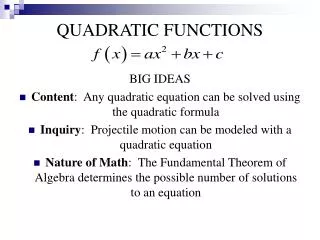
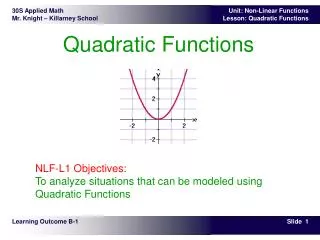
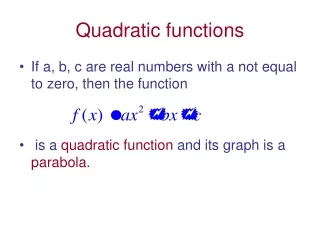
Quadratic functions: equation A function f (“rule”) with an equation of the form f(x) = y=ax² + bx + c where a 0 is called a quadratic function
Quadratic equations Revenue equal to 1872? 2x²+ 40x + 1722 = 1872 • 2x²+ 40x + 1722 1872 = 0 • 2x²+ 40x 150 = 0 We have to solve the equation 2x²+ 40x 150 = 0. Finding SOLUTIONS of an equation of the form ax² + bx + c = 0 QUADRATIC EQUATION
Quadratic functions: definitions • Function f (“MACHINE”!) with an equation of the form f(x) = ax² + bx + c where a 0. Or: function having an explicit equation of the formy = ax² + bx + c where a 0. • Discriminant: d = b² 4ac
Quadratic equations • Equations that can be written in the form ax² + bx + c = 0 where a0. • Solutions: if discriminant d > 0: two solutions if discriminant d = 0: one solution if discriminant d < 0: no solutions Discriminant: d = b² 4ac 2x²+ 40x 150 = 0 Group excursion:
Quadratic functions: exercises • exercise 1 (a), (c) and (e) • supplementary exercises: rest of exercise 1
Quadratic function: graph Quadratic functions: graph is a PARABOLA Graphical interpretation of y=ax²+bx+c=0 ? Zero’s, solutions of this quadratic equations correspond to intersections with the horizontal x-axis Sign of the discriminant determines the number of intersections with the horizontal axis
Quadratic function: graph sign of the discriminant determines the number of intersections with the horizontal axis sign of the coefficient of x 2 determines the orientation of the opening
Quadratic function: maximum Maximum revenue? In this case you can find it e.g. using the table: So: 10 supplementary participants (30 participants in total) This can also be determined algebraically, based on a general study of quadratic functions!
Quadratic function: maximum x-coordinate of the vertex of the parabola: the vertex determines the minimum/maximum function value Group excursion:
Quadratic functions: exercises • Exercise 2 (f1 and f5) • Exercise 3, 7, 5 supplementary exercises: • rest of exercise 2 • exercise 4, 6, 8 and 9 Figure
Quadratic inequalities Solve the inequality i.e. Find all x for which standard form graph of LHS conclusion: x-2 or x7 interval notation: ]-,-2][7,[
Quadratic inequalities inequalities that can be reduced to the form ... and determine the common points with the x-axis by solving the EQUATION
Quadratic functions: exercises • Exercise 10 (a) • Exercises 11 (a), (c) Supplementary exercises: • Exercises 10 (b), (c), (d) • Exercises 11 (b), (d)
Quadratic functions: Summary • 3 representations : table, equation, graph • Quadratic equations , zero’s, discriminant d • Graph: Parabola interpretation of d, a Maximum, vertex • Quadratic inequalities
STUDYING MATH is DOING A LOT OF EXERCISES YOURSELF, MAKING MISTAKES AND DOING THE EXERCISES AGAIN CORECTLY
Exercise 7 Back