Active Appearance Models
This document summarizes the key principles of Active Appearance Models (AAM), focusing on the modeling of objects in terms of shape and grey-level appearance. It explains the synthesis of new model instances, parameter adjustment for optimal fit, and the use of Principal Component Analysis (PCA) for data preprocessing. The iterative approach to model fitting is discussed, including the significance of landmark annotations, alignment of shapes, and normalization techniques. The paper emphasizes the importance of a good initial guess for achieving accurate fitting of models onto image data.

Active Appearance Models
E N D
Presentation Transcript
Active Appearance Models AG KI, Journal Club 03 Nov 2008
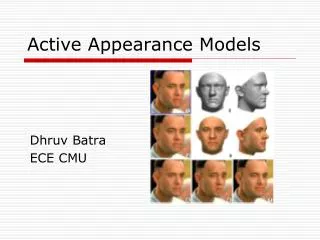
The Idea • Objects are modelledin shape and grey-level appearance (training necessary) • New model instances are synthesized and matched onto the new image • Model parameters are altered according to the quality of the fit
The Idea • Generate new model x x = μ + P*b from mean model μ and some (b) linear combination of principal components P • Fit Ix to image region Ii, by altering b according to (Ix – Ii ) = ΔI offline online
creating the model: step by step • annotate landmark points • align the shapes • PCA (find modes of shape variation) • make data shape-free • normalize grey values • PCA (find modes of grey value variation) • PCA (on the combined model) Example: 122 landmarks for the face image
What the … PCA? BASICS • Principal Component Analysis (aka: Karhunen-Loeve Transform)
PCA, cont. BASICS • used for decorrelation, dimension reduction, generalization • Data is assumed to be: • Linear • Gaussian (unimodal) • Principal components: eigenvectors of the Covariance matrix
Fitting the model onto the image /* reminder */ • x = μ + P*b • simplest approach: Δb = A*ΔI • „learn“ A: • perturbate known model b‘ = b + Δb and store the change of image ΔI • Find A by multi-variate linear regression • (note:) A connects grey-value appearance with all model params
Optimization vs. Learning Small perturbations optimum optimum Initial position
Extras • Iterative Approach: • b1 = b0 + kΔb with k \in {0.25, …, 2.0} • evaluate error and accept new estimate b1, if better fit, otherwise change k • Multi-resolution: use pyramids to extendthe prediction to greater ranges
AAMs: Properties • good results if initial guess within 20 pixels and 10% scale • depends on training image background appearance, too