Download
1 / 8
100 likes | 256 Views
In this lesson, we explore how to measure and draw acute and obtuse angles using a protractor accurately. We will address critical learning questions like how to measure angles to the nearest degree and how to draw them. You'll learn the proper alignment of the protractor by ensuring the upside-down 'T' is at the vertex of the angle. Follow step-by-step instructions to read from the appropriate scale and avoid common mistakes. Gain confidence in measuring angles and strengthen your geometry skills effectively!

E N D
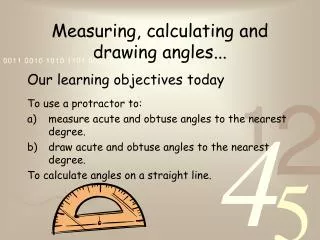
Measuring, calculating and drawing angles... Our Learing Questions: Can we use a protractor to: • measure acute and obtuse angles to the nearest degree? • draw acute and obtuse angles to the nearest degree? To calculate angles on a straight line?
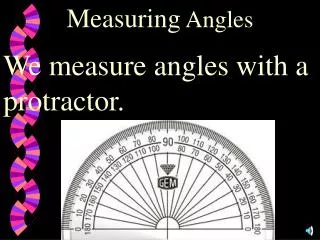
What do we use to help us? A protractor Here is a standard protractor like you use in the classroom.
When we use a protractor, we need to line it up correctly. You need to make sure the protractor is lined up correctly. Is this ready to measure the angle?
Were you right......................it wasn’t Look for the upside down ‘T’ in the middle of the straight line on your protractor. This needs to be exactly on the vertex of your angle.
We need to remember..... It doesn’t matter which way round the angle is, you ALWAYS need to line the upside down ‘T’ to the vertex of the angle.
Now you are ready. Read from the 0°, and follow the inner set of numbers.
Once you reach 30° you need to be careful!!! You then need to look at the 1° markings on the outer set of numbers.
What does it measure? This angle measures 35°.