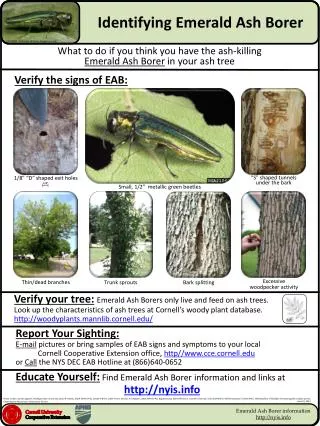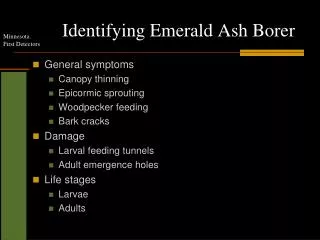
Emerald Ash Borer
100 likes | 248 Views
Learn about the destructive impact of the Emerald Ash Borer on trees and economies, its life cycle, spread, and control methods. Tens of millions of trees have perished due to this invasive species, causing losses in billions of dollars. Understand the negative effects, infested areas in the U.S., and why public concern is warranted. Explore the origin of the borer, its spread pattern, and the challenges it poses to forestry and quarantine efforts.


Emerald Ash Borer
E N D
Presentation Transcript
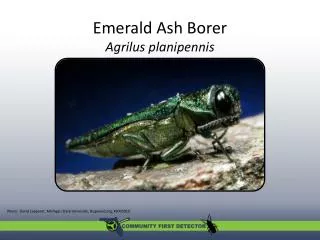
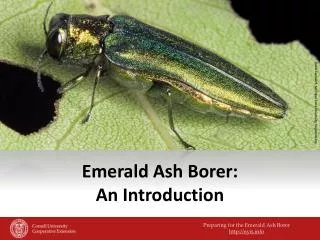
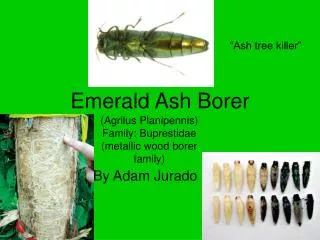
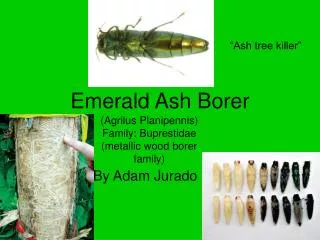
“Ash tree killer” Emerald Ash Borer (Agrilus Planipennis) Family: Buprestidae (metallic wood borer family) By Adam Jurado
Life Cycle • Hundreds of larvae are laid under tree bark for the winter • Larvae feeds on the tree’s phloem • In June and July, pupation occurs, which can cause the bark to slough off • Newborn females reproduce within a week after birth • 1, 2 and 3 year life cycles are typical
Infested Areas of the U.S. • Northeastern US • Illinois, Wisconsin, Missouri, Michigan, Ohio, Pennsylvania, Maryland, West Virginia, Virginia, New York
Negative Effects • Canopy thinning • Bark sloughing • Money lost for property owners and businesses • Death of the Fraxinus, Pterocarya, Ulmus and Juglans trees • Spread of infestation
Reason for Public Concern • Tens of millions of trees have died • The beetles are monitored by the USDA • Nursery operators, forest workers, municipalities and property owners have lost billions of dollars since introduction of the species
Place of Origin • China, South Korea, North Korea, Japan, Mongolia and Taiwan • The emerald ash borer was carried on boats and airplanes, probably on wood shipping crates • First sighting in the US was in 2002, in southeastern Michigan
Spread of the Borer • The emerald ash borer spreads a half a mile each year, however it can fly 6 miles in 24 hours • After introduction in 2003, the borer has spread throughout Northeastern and North-Central US, and Southeastern Canada
Why the Borer is a Problem • Deforestation • Quarantines by the USDA are inconvenient for when firewood needs to be shipped • Property damage, and spread of the emerald ash borer are hard to control • Every year, the borer expands its domain
Methods of Control • Survey and protection programs • State and local governments are alerted • Fixing the infestation first in populated areas • Killing live ash trees • Quarantines
Bibliography • Ashalert.osu. 9 September 2011. The Ohio State University. 20 September 2011 <http://ashalert.osu.edu/>. (life cycle) • Datcpservices.Wisconsin’s Emerald Ash Borer Information Source. 20 September 2011 <http://datcpservices.wisconsin.gov/eab/index.jsp>. (rate of spread) • Emeraldashborer. Emerald Ash Borer University. 20 September 2011 <http://www.emeraldashborer.info/>. (current distribution) • Emeraldashborer. USDA. 20 September 2011. <http://www.emeraldashborer.info/files/edpacket.pdf>. (methods of control) • Googleimages. Google Images. 20 September 2011 <Borer distribution>. • Googleimages. Google Images. 20 September 2011 <Eastasiamap>. • Googleimages. Google Images. 20 September 2011 <Infested tree>. • Googleimages. Google Images. 20 September 2011 <Life cycle>. • Na.fs.fed. United States Forest Service. 20 September 2011 <http://www.na.fs.fed.us/fhp/eab/>. (origin) • Themorningsun. Satayut, Lisa. 11 July 2011. The Morning Sun. 20 September 2011 <http://www.themorningsun.com/articles/2011/07/12/news/doc4e1c9f425b911553913307.txt>. (article)