Understanding Periodic Table Properties: Trends in Valence Electrons and Ions
This guide explores key trends in the periodic table, focusing on the number of valence electrons and the types of ions formed by representative elements. It analyzes the locations of metals, nonmetals, and metalloids, as well as their phases at room temperature. The significance of group and period numbers is explained, alongside the classification of elements such as alkali metals, alkaline earth metals, transition metals, halogens, and noble gases. Insights into the characteristics of ions, octet rule, and properties of metals are also covered for a comprehensive understanding.

Understanding Periodic Table Properties: Trends in Valence Electrons and Ions
E N D
Presentation Transcript
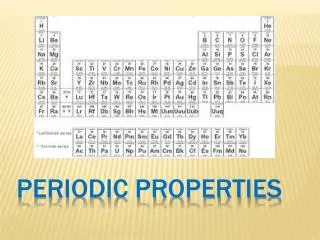
SPS4a Determine the trends of the following: • Number of valence electrons • Types of ions formed by representative elements • Location of metals, nonmetals, and metalloids • Phases at room temperature Periodic Properties SPS4b Use the Periodic Table to predict the above properties for the representative elements.
Groups • The group number is the number assigned to a verticalcolumn on the periodic table. • Another name for group is a Family • There are 18 groups in the periodic table. • Groups 1, 2, 13 – 18 are representative
Periods • 1. The period number is the number assigned to a horizontalrow on the periodic table. • 2. The number of protons increase from left to right across a period. • 3. This number is the atomic number. • The period number indicates how many energy levels (rings) each atom has.
METALS • shiny-luster • solids (except Hg) • malleable • ductile (stretch to wire) • conduct heat & electricity • most elements are metals
NONMETALS • solids, liquids & gases • luster-dull • brittle • poor conductors • upper-right hand corner (& H)
Metalliods • along stairstepline – between B & Al (Al is not a metalloid!) • classified as nonmetals but conduct heat and electricity under certain conditions • some metal & nonmetal properties
Alkali Metals Periodic Family Names Alkaline Earth Metals Nobl e gases Halogens (D- Block) <---Transition Metals-----------> (F—block) <-----------------Inner transition------------------>
Group 1 - Alkali Metals • soft, shiny • reacts violently with water • VERY reactive, one valence e- to lose; • cation
Alkali metals • http://www.youtube.com/watch?v=m55kgyApYrY&safety_mode=true&persist_safety_mode=1
Group 2 - Alkaline Earth Metals • 2 valence e-; cation • reactive
http://www.youtube.com/watch?v=m55kgyApYrY&safety_mode=true&persist_safety_mode=1http://www.youtube.com/watch?v=m55kgyApYrY&safety_mode=true&persist_safety_mode=1
Transition Metals • Groups 3-12 • Ions change – changes properties • NOT REPRESENTATIVE!
Halogens • -Group 17 • -1 ions, highly reactive • 7 valence e-
Noble Gases • Group 18 • unreactive, 8 valence e- • exist as single atoms, inert
Phases of Elements • 1. Liquids: You must know: Hg and Br • 2. Gases: Don’t memorize, but you need to know their general location. Gases are towards the right side of the periodic table. • 3. Solids: All metals, except Hg - mercury
Vocabulary to know • Valence electron: electrons in the outermost energy level (ring) • Cation: (+) charged ion • Anion: (-) charged ion
Why ions form... • To get as close to an “octet” as possible
Octet Rule • Atoms tend to share, gain or lose electrons to have a set of eight (8) electrons in their outer shell.
Metals • Most elements are metals. • 88 elements to the left of the stair step line are metals or metal like elements.
Metals • Shiny, silvery, solids
Ions are …. • Charged atom or group of atoms
Ions are formed…. • By loss or gain of electrons
Positive ions • Cations
Negative ions • anions