Active Capture and Folk Computing
This paper discusses the concept of "Active Capture," which involves the use of intelligent cameras designed to guide and capture human actions interactively. Covering automatic camera calibration and advanced capture algorithms, it explores practical applications such as automated movie trailers, sports instruction, and telemedicine. The authors present a framework for designing user-centric capture systems that integrate computer vision and audio processing, allowing for real-time editing and user interaction. This research aims to enhance multimedia acquisition systems for various fields, improving user experience and accessibility.

Active Capture and Folk Computing
E N D
Presentation Transcript
Active Capture and Folk Computing Ana Ramírez and Marc Davis ICME 2004 – Taipei, Taiwan 29 June 2004 UC Berkeley - Garage Cinema Research - Group for User Interface Research
Smart Multimedia Acquisition Systems • First two papers – automatic camera calibration • Image • Audio • Third paper – understand structure of what is being captured to edit in real time • Active capture - smart cameras that interactively guide and capture human action
Outline • Sample applications • Active Capture • Designing Active Capture algorithms • Future work
SampleApplications Automatic Movie Trailers • Video of capture process Play Video
SampleApplications Automatic Movie Trailers • Video of automatically created movie trailer Play Video
SampleApplications Sports Instruction
SampleApplications Telemedicine Rural Town Large City • leishmaniasis
SampleApplications Automated Health Screening Rural Town Large City • leishmaniasis
Active Capture Direction/ Cinematography Capture Interaction Active Capture Human- Computer Interaction Computer Vision/ Audition Processing
Active Capture Direction/ Cinematography Capture Interaction Active Capture Human- Computer Interaction Computer Vision/ Audition Processing
Active Capture Direction/ Cinematography Capture Interaction Active Capture Human- Computer Interaction Computer Vision/ Audition Processing
Active Capture Direction/ Cinematography Capture Interaction Active Capture Human- Computer Interaction Computer Vision/ Audition Processing
Active Capture Direction/ Cinematography Capture Interaction Active Capture Human- Computer Interaction Computer Vision/ Audition Processing
Active Capture • Traditionally, signal processing algorithms avoid interacting with the user • Signal processing + interaction => more sophisticated recognizers • How to design hybrid algorithms that involve capture, interaction, and processing
Components of Active Capture Algorithms • Simple computer vision and audition recognizers / sensors • Motion • Eyes • Sound • Desired action in terms of recognizers • Interaction script
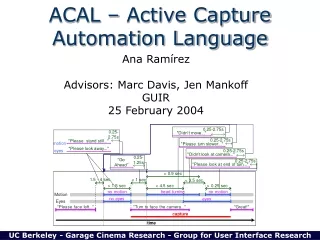
Design Process • Input: • Desired action = head turn • Recognizers = motion, eyes Motion Eyes time
Design Process • Input: • Desired action = head turn • Recognizers = motion, eyes • Step 1: • Express desired action in terms of recognizers No Motion Motion No Motion Motion Eyes No Eyes Eyes time
Design Process • Input: • Desired action = head turn • Recognizers = motion, eyes • Step 1: • Express desired action in terms of recognizers • Step 2: • Design interaction script
Design Process – Step II Play Video
Design Process – Step II Play Video
Design Challenges Step I - Description of action • Approximate timing • Strict and non strict ordering Step II – Interaction script • What to do if something goes wrong – mediation
Step I - Action Description Visual Language • Observations • Commands • Capture • Time constraints • Strict ordering • Non-strict ordering
Step I - Action Description Visual Language • Observations • Commands • Capture • Time constraints • Strict ordering • Non-strict ordering
Step I - Action Description Visual Language • Observations • Commands • Capture • Time constraints • Strict ordering • Non-strict ordering
Step I - Action Description Visual Language • Observations • Commands • Capture • Time constraints • Strict ordering • Non-strict ordering
Step I - Action Description Visual Language • Observations • Commands • Capture • Time constraints • Strict ordering • Non-strict ordering
Step I - Action Description Visual Language • Observations • Commands • Capture • Time constraints • Strict ordering • Non-strict ordering
Step I - Action Description Visual Language • Observations • Commands • Capture • Time constraints • Strict ordering • Non-strict ordering
Step II – Interaction Script Contextual Inquiries • Golf instructor • Aikido instructor • 911 emergency phone operator • Triage nurse • Children’s portrait photographer • Film and theatre directors [Jeffrey Heer, Nathaniel S. Good, Ana Ramirez, Marc Davis, and Jennifer Mankoff. “Presiding Over Accidents: System Direction of Human Action.” In: Proceedings of the Conference on Human Factors in Computing Systems (CHI 2004) in Vienna, Austria. ACM Press, 463-470, 2004. ]
Step II – Interaction Script Direction and Feedback Strategies • External aids Play Video
Step II – Interaction Script Direction and Feedback Strategies • Decomposition and “Show” Play Video
Step II – Interaction Script Direction and Feedback Strategies • Method shift from “Show” to “Tell” Play Video
Step II – Interaction Script Direction and Feedback Strategies
Summary • Active Capture – smart cameras that interactively guide and capture human action • Sample applications • Automated health screening • Automated movie clips • Sports trainer • Design Challenges • Description of action • Interaction script
Future Work • Support design and implementation of Active Capture applications • Evaluate the relative contribution of signal analysis and user interaction in these hybrid algorithms
Questions Ana Ramírez anar@cs.berkeley.edu www.cs.berkeley.edu/~anar Garage Cinema Research http://garage.sims.berkeley.edu Group for User Interface Research http://guir.berkeley.edu