Download

1 / 19
190 likes | 310 Views
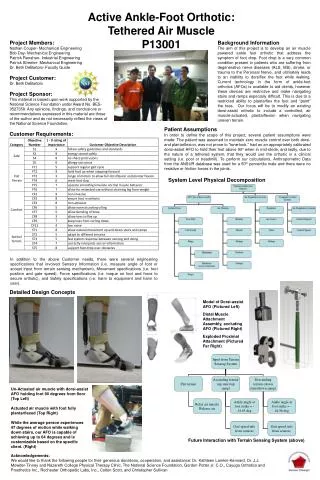
This project presents the development of an innovative Active Ankle-Foot Orthotic (AFO) aimed at improving mobility in individuals with foot drop, a common issue for stroke survivors and patients with other neuromuscular conditions. Unlike traditional passive AFOs, this active design enables safe movement on various terrains including stairs and ramps. Key features include a mechanical locking system, advanced sensors for terrain detection, and a lightweight design. The project team consists of engineers and faculty from Rochester Institute of Technology, focused on enhancing user experience and comfort.

E N D
SBC2013-14689:Un-Tethered, Active Ankle-Foot Orthotic Rochester Institute of Technology Rochester, NY
The Team • Team Members: • Pattie Schiotis – Team Manager (ME) • Shane Reardon – Lead Engineer (ME) • Dana Kjolner (EE) • Robert Ellsworth (EE) • Sam Hosig (CE) • John Williams (CE) • Faculty Guide: Dr. Elizabeth DeBartolo
Agenda • Introduction • Project Background • Key Customer Needs • System Architecture • Component Breakdown • Mechanical Locking System • Electronics Circuit and PCB • Sensors • Microcontroller • Testing Results • Future Work • Demo
Project Background: Foot Drop • Inability to dorsiflex the foot due to loss of control of peroneal nerve • Lasting side effect of a stroke, affecting approximately 20% of stroke survivors • ~20 million people per year • Condition can also occur as a side effect of ALS (Lou Gherig's Disease), Multiple Sclerosis, or injury to the peroneal nerve, increasing the number of people affected • People with this condition have difficulty maintaining a proper gait cycle • “Foot crash”
Project Background: AFO Market • Patients have adopted the use of ankle foot orthotics (AFOs) to aid with dorsi flexion • Market consists mostly of “passive” devices • Rigid braces which prevent unwanted plantar flexion. Foot is always pointed in the upwards direction. • These devices do not allow for safe maneuvering down stairs and ramps • The goal of this project is to design and develop an “active” AFO which allows safe movement on flat surfaces as well as up and down stairs and ramps
Assumptions & Constraints • User will have no ability to either plantar-flex or dorsi-flex their foot • Side to side stability of the foot will be ignored • Worst case will be analyzed: • 95 percentile male having heavy foot. • Fast walker – gait cycle less than 1 second. • Device may not use air muscles as an actuation source • AFO Custom made for each client
Key Customer Needs • Safety • Portable • Lasts all day without charging/refueling • Lightweight • Tolerable to wear all day • Reliable • Accommodates Flat Terrain • Accommodates Special Terrain • Stairs • Ramps • Obstacles • Comfortable • Aesthetically Pleasing • Durable • Water Resistant • Corrosion Resistant • Salt & Environment • Biocompatibility • Convenient • Easy to put on and take off Primary Needs: Secondary Needs:
System Architecture • CAD model Reservoir Sensors Battery Processor Valve Piston/Cylinder Mounting Bracket
Mechanical Locking System Concept: Selectively prevent foot from plantar flexing while off the ground • Piston-cylinder arrangement attached posterior to heal and calf via 2 pin joints • Piston actuates within cylinder as dorsi & plantar flexion occurs
Mechanical Locking System • Valve on top of the cylinder is closed • Water inside cylinder is compressed by piston upon plantar-flexion • Motion of piston is therefore restricted, preventing plantar flexion • Valve is open • Water is free to travel between cylinder and reservoir upon actuation of piston • Allows for plantar and dorsi flexion “Locked” Mode “Free” Mode
Electronic Circuit and Board Design Connector LED SD Card Switch
Sensors • Utilize sensor system developed by MS student Christopher Sullivan • Vertical sensor determines if the foot is on or off ground • Forward sensors detects upcoming terrain
Microcontroller • Processing path of microcontroller
Testing Results • Range of Motion • 70.03º-147.27º • Weight of Device • 2.42 lbs • Terrain prediction • Detects flat, descending stairs and ramps • System Response Time • Average ~300ms
Areas of Improvement • Create smaller electronics box • Reduce weight, improve aesthetics, switch in correct location • Different battery • Reduce size and weight, improve usage time • Recommend using plastic fittings • Weight reduction, corrosion resistance, could not find in store • SD card expansion board • Improve data collection • Human Trials with AFO that fits user • More accurate data collection
Economic Feasibility • Budget breakdown…