Section 4: World War II
120 likes | 264 Views
This overview of World War II highlights critical events, including the rise of dictators, the impact of isolationism, and the Holocaust. Key points include Hitler's aggression in Europe, America's shift from neutrality after Pearl Harbor, and the roles of Allied and Axis Powers. The war's effects on society, including the military contributions and challenges faced by women and minorities, are also discussed. Additionally, the G.I. Bill's role in aiding veterans and the economic changes due to rationing and Victory Gardens are explored.


Section 4: World War II
E N D
Presentation Transcript
Section 4: World War II • What words do I need to know? • isolationism • dictator • appeasement • World War II • Holocaust • ration • G.I. Bill
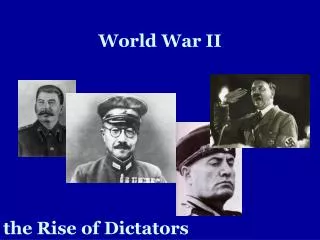
Increasing Tensions • Dictator: individual who ruled a country through military strength
The War Begins • 1938: Hitler’s Germany attacks France to “take back” land lost in WWI (Rhineland) • Sent troops to take over Austria, Czechoslovakia, and Poland • Great Britain and France declared war • Soviet Union invaded nearby countries and agreed to split Poland with Germany • By 1940, Hitler controlled Denmark, Norway, Holland, Belgium, Luxembourg and a large part of France and began bombing Great Britain
A Neutral United States • Most Americans did not want to get involved in the war, but Roosevelt wanted to help Britain • Hitler turned on Stalin in 1941 and invaded the Soviet Union • Lend-lease: policy to lend or lease (rent) weapons to Great Britain and the Soviet Union • American ships began escorting British ships in convoys
“A Day that Will Live in Infamy” • President Roosevelt stopped exports to Japan to protest its expansion into other countries • Exports of oil, airplanes, aviation gasoline and metals were stopped • The Japanese attacked the U.S. Navy fleet at Pearl Harbor, Hawaii on Dec. 7, 1941 • Japan hoped to destroy the fleet giving them control of the Pacific Ocean • The USA declared war on Japan • Allied Powers: USA, Great Britain, Soviet Union • Axis Powers: Germany, Italy, Japan
American Military Forces • Millions of Americans enlisted after the attack on Pearl Harbor • 330,000 women joined – could not serve in combat roles • Segregation in the military kept African American and white service men in different units • Tuskegee Airmen: famous African American flyers of the Army Air Force
The War in Europe • 1942-1943: British and American troops won control of Africa • 1943: Mussolini overthrown and Italy joined the Allies • American general Dwight D. Eisenhower coordinated plan to recapture Europe • D-Day: June 6, 1944 – Allied forces land in northern France • Early 1945: Germans pushed out of France • April 1945: Soviet and American troops meet and Germany surrenders – Hitler commits suicide
Georgia Loses a Friend • President Roosevelt visited Georgia often at his “Little White House” in Warm Springs • His polio symptoms were eased in the mineral springs • April 24, 1945: President Roosevelt died at Warm Springs • Millions of Georgians and Americans mouned • Vice President Harry Truman became president
The War in the Pacific • 1942: Japan expanded its territory throughout the Asian Pacific region • 1945: Allied forces began to retake Japanese controlled lands • Japan refused to surrender • President Truman authorized the use of atomic bombs to force Japan’s surrender • Enola Gay: plane that dropped first atomic bomb on Hiroshima, Japan • Japan surrendered after a second atomic bomb dropped on Nagasaki • Over 50 million people died in the war
The Holocaust • The Holocaust: name given to the Nazi plan to kill all Jewish people • Auschwitz, Buckenwald, Dachau, Treblinka, Bergen-Belsen infamous concentration camps where Jews and others were executed • 6 million people killed in the Holocaust
Georgia During World War II • 320,000 Georgians joined the armed forces – over 7,000 killed • Military bases were built in the state which improved the economy • Farmers grew needed crops – income tripled for the average farmer • Limits were put on the consumption of goods such as gasoline, meat, butter, and sugar (rationing) • Students were encouraged to buy war bonds and defense stamps to pay for the war • Victory Garden: small family gardens to make sure soldiers would have enough food • POW (prisoner of war) camps in Georgia at some military bases
The War’s Effects on Society • Everyone was expected to help in the war effort • Women began working in jobs to replace men who had gone to war • G.I. Bill: law to help returning soldiers adapt to civilian life • Low cost loans for homes or business • College education opportunities • Women and African Americans did not want to go back to the kind of life they had before the war Click to return to Table of Contents.