Download
1 / 14
140 likes | 273 Views
This article explores food chains, illustrating the sequence of organisms and how energy and nutrients transfer through ecosystems. It discusses the abundance of producers compared to consumers and explains why producers are typically more numerous. The article also addresses energy loss at each trophic level, with only about 10% of energy being transferred. Illustrative analogies, like heating a house and car efficiency, demonstrate energy wastage. Lastly, it emphasizes the benefits of consuming grains directly rather than meat from grain-eating animals for improved energy efficiency.

E N D
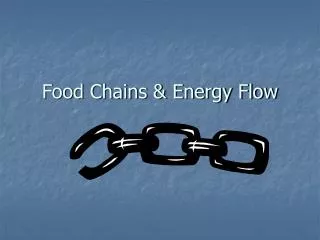
Food Chains • Food chain: sequence of organisms, showing how energy and nutrients move from one to another
Food Chains • Which are more numerous in an ecosystem: producers or consumers? • Producers are always more numerous than consumers, why?
Energy Loss • Of the energy that an organism consumes, only a small fraction (ecological efficiency of about 10%) is transferred to the next trophic level
Where does that energy go? • Most of the energy is lost as heat That’s hot.
House Analogy • Just like how much of the energy used to heat a house is wasted, much of the energy used by organisms is wasted
Efficiency Example • Cars are only about 25% efficient • Only 25% of the total energy in gasoline is used to make cars move • What happens to the other 75%???
Energy Efficiency • Why is it more energy efficient to eat grains directly, rather than the meat of grain-eating animals? 15 lbs. of feed 1 lb. of beef
Energy Efficiency • Why is it more energy efficient to eat grains directly, rather than the meat of grain-eating animals? 6 lbs. of feed 1 lb. of pork
Energy Efficiency • Why is it more energy efficient to eat grains directly, rather than the meat of grain-eating animals? 5 lbs. of feed 1 lb. of chicken
Energy Efficiency • Why is it more energy efficient to eat grains directly, rather than the meat of grain-eating animals? 2 lbs. of feed 1 lb. of fish
Summary Question • Why do food chains rarely have more than 4 or 5 trophic levels?