Qualitative and Limited Dependent Variable Models
120 likes | 265 Views
This chapter delves into the intricacies of binary dependent variable models in economic decision-making, where choices are often binary, such as whether to use a computer or buy organic food. It discusses critical models including the Linear Probability Model (LPM) and the Probit and Logit models, addressing their implications and limitations like heteroscedasticity and implausible predicted values. The chapter also covers advanced techniques like multinomial regression, ordered choice models, and the Heckman procedure to correct for selection bias, equipping researchers with tools to analyze limited dependent variables effectively.


Qualitative and Limited Dependent Variable Models
E N D
Presentation Transcript
Qualitative and Limited Dependent Variable Models Chapter 18
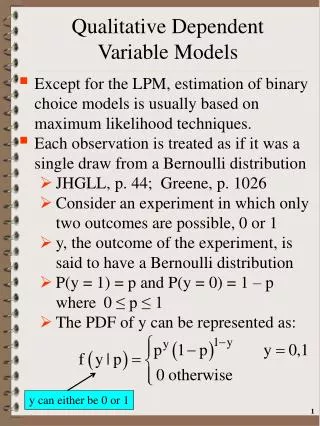
Binary dependent variables • Many economic choices are either or; • Farmers either use a computer or they don’t; • People either buy organic food or they don’t; • What are the factors that influence such decisions?
Problems with the LPM • Heteroscedasticity • Implausible predicted values • a consequence of the linear relationship.
Maximum Likelihood Estimation What is the probability of observing three observations:
Interpretation of the Probit Model Normal pdf
Logit model PDF: CDF
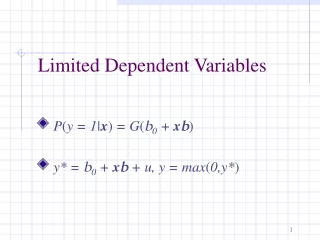
Other Models • Multinomial • Influence of individual’s attribute on choice of shop. • Influence of product attributes on choice of product (choice experiments, conjoint analysis) • Multinomial logit, conditional logit, multinomial probit. • Ordered choice • Strongly disagree, disagree neutral etc. • Ordered probit/logit. • Count data • Number of trips to the supermarket. • Poisson regression.
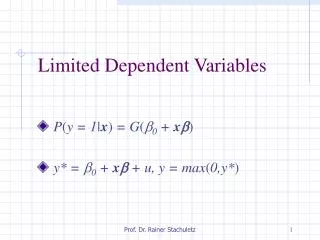
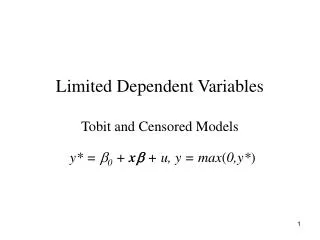
Limited Dependent Variables • Tobit • Deals with the problem of censoring at zero. • Subsistence farmers sales on the market. • OLS is biassed • Sample selection • Average earnings of women. • Heckman procedure • equation 1: probit to explain participation. • equation 2: least squares wage equation including the inverse mills ratio.