Download
1 / 8
0 likes | 0 Views
Comprehensive guide to preparing your facility for successful forklift collision detection system deployment. Learn assessment, training, and implementation best practices

E N D
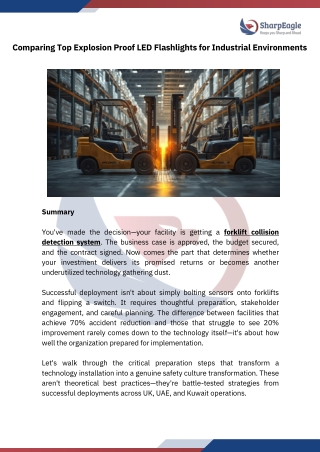
Comparing Top Explosion Proof LED Flashlights for Industrial Environments Summary You've made the decision—your facility is getting a forklift collision detection system. The business case is approved, the budget secured, and the contract signed. Now comes the part that determines whether your investment delivers its promised returns or becomes another underutilized technology gathering dust. Successful deployment isn't about simply bolting sensors onto forklifts and flipping a switch. It requires thoughtful preparation, stakeholder engagement, and careful planning. The difference between facilities that achieve 70% accident reduction and those that struggle to see 20% improvement rarely comes down to the technology itself—it's about how well the organization prepared for implementation. Let's walk through the critical preparation steps that transform a technology installation into a genuine safety culture transformation. These aren't theoretical best practices—they're battle-tested strategies from successful deployments across UK, UAE, and Kuwait operations.
Pre-Implementation Assessment: Know Your Starting Point Before installers arrive, you need a clear understanding of your current state. This baseline assessment serves multiple purposes: it identifies your highest-risk areas, provides data for measuring improvement, and reveals potential deployment challenges. Conduct a comprehensive safety audit: Document your last 12-24 months of forklift incidents, near-misses, and safety observations. Where do accidents cluster? Which operators are involved most frequently? What times of day see the highest incident rates? This data guides where to deploy technology first and most intensively. Map your facility layout: Create detailed floor plans showing traffic patterns, blind intersections, high-congestion zones, and areas with mixed pedestrian-forklift traffic. Modern anti collision systems for forklift fleets can be customized based on zone-specific risk profiles, but only if you've identified these zones beforehand. Assess infrastructure requirements: Does your facility have adequate network coverage for system connectivity? Are there mounting points for infrastructure components like temperatures or environmental equipment housings? Identifying these needs early prevents costly mid- deployment discoveries. base conditions stations? Will extreme specialized require
SharpEagle's pre-deployment assessment services help clients identify these critical factors before installation begins, ensuring smoother implementations and faster time-to-value. Engage Stakeholders Early and Often Technology implementations fail when they're done TO people rather than WITH people. Your operators, supervisors, maintenance teams, and even warehouse workers need to understand what's coming and why it matters. Involve operators in planning: The people driving forklifts daily possess invaluable insights about operational challenges and high-risk situations. Engage them early, solicit their input, and incorporate their feedback into deployment plans. Operators who feel heard become advocates rather than resistors. Educate leadership: Executives and managers must understand that deployment isn't the finish line—it's the starting line. They need to set expectations for a learning curve, support operators during adjustment periods, and commit resources for ongoing training and system optimization. Address concerns proactively: Some operators worry that collision detection is surveillance or performance monitoring in disguise. Others fear the technology will make their jobs harder or imply distrust in their skills. Acknowledge these concerns directly and honestly, explaining how the system enhances rather than replaces operator expertise. Transparent communication transforms potential resistance into engagement.
Develop a Phased Rollout Strategy Attempting facility-wide deployment overnight invites chaos. Successful implementations follow phased approaches that build momentum and allow learning. Start with pilot zones: Select 2-3 high-risk areas or a subset of your forklift fleet for initial deployment. This contained scope allows troubleshooting, operator familiarization, and system optimization before full-scale rollout. Build on early wins: Document improvements in pilot areas—accident reduction, near-miss data, operator feedback. Share these success stories to build organizational confidence and enthusiasm for wider deployment. Expand systematically: Use insights from pilot deployment to refine processes, training, and configurations before expanding to additional zones or vehicles. Each phase should be slightly larger and smoother than the last. This measured approach reduces risk and improves ultimate outcomes compared to big-bang deployments.
Prepare Your Physical Environment The forklift collision detection system performs best when the operating environment is optimized for its success. Improve lighting in critical areas: While many detection technologies work in poor light, adequate illumination enhances system performance and provides operational benefits beyond safety. Clear sightlines where possible: Trimming unnecessary obstacles and improving visibility complements technological detection, creating layered protection. Establish designated pedestrian pathways: Physical infrastructure like painted walkways, barriers, and signage work synergistically with detection systems, creating clearer separation between vehicle and pedestrian zones. Mark high-risk zones: Visual cues like floor markings at blind intersections help operators understand where extra caution is needed, reinforcing technological alerts with environmental awareness. Develop Comprehensive Training Programs Technology only works when people know how to use it properly. Training determines whether your anti collision system for forklift operations becomes a valued safety tool or an annoying distraction. Create role-specific training: Operators need hands-on instruction with the actual systems they'll use. Supervisors need to understand system capabilities, data interpretation, and how to coach operators. Maintenance personnel need technical training for basic troubleshooting and upkeep.
Use realistic scenarios: Theoretical classroom training has limited value. Hands-on simulation using your actual forklifts in your actual facility conditions creates genuine competence. Establish ongoing education: Initial training isn't sufficient. Plan for refresher sessions, advanced training for experienced users, and continuous education as systems are updated or expanded. Document everything: Create clear reference materials, quick-start guides, and troubleshooting resources that operators can access when questions arise. SharpEagle provides comprehensive training programs tailored to your specific equipment and operational context, ensuring your team is fully prepared for go-live. Establish Clear Protocols and Procedures How should operators respond to different alert types? What happens when the system triggers warnings? Who do operators contact when problems arise? Answer these questions before deployment, not during it. Define response procedures: Create clear protocols for how operators should react to various system alerts. What does a Level 1 warning require versus a Level 3 emergency alert? Establish escalation paths: Operators need to know who to contact for technical issues, false alarm reports, or safety concerns. Define clear escalation procedures and ensure contact information is readily available.
Plan for Data Management and Analysis Your forklift collision detection system will generate volumes of valuable data. Prepare to capture, analyze, and act on this information. Designate data ownership: Who monitors system alerts? Who analyzes incident data? Who generates reports for management? Assign clear responsibilities. Establish reporting cadence: Decide how frequently you'll review safety data, what metrics matter most, and how findings will be communicated to stakeholders. Create action protocols: Data without action is waste. Establish processes for translating insights into concrete safety improvements— additional training, layout modifications, procedure changes, or targeted interventions. Prepare for the Adjustment Period Even the best implementations experience growing pains. Prepare your organization for the reality that the first few weeks may involve challenges. Set realistic expectations: Alert frequency may seem high initially as the system identifies situations that operators previously navigated through habit or luck. This is the system doing its job, not malfunctioning. Establish rapid-response support: During the first weeks, ensure technical support is readily available to address issues quickly, maintaining operator confidence and momentum.
Deploying a forklift collision detection system represents significant investment and organizational change. The technology itself is proven and effective, but realizing its full potential requires thoughtful preparation, stakeholder engagement, comprehensive training, and commitment to the implementation process. Facilities that prepare thoroughly—engaging operators, optimizing environments, developing clear procedures, and committing to ongoing improvement—consistently achieve superior safety outcomes and faster ROI. Those that treat deployment as purely technical installation struggle to achieve the transformational results that make the investment worthwhile. Ready to prepare your facility for successful collision detection deployment? SharpEagle Technology provides end-to-end implementation support, from pre-deployment assessment through post-installation optimization. Our experienced team has guided dozens of UK, UAE, and Kuwait facilities through successful deployments, and we understand the preparation steps that separate good implementations from great ones. Contact us today for a comprehensive deployment planning consultation—because the success of your anti collision system for forklift operations begins long before installation day. Contact Us: SharpEagle Phone: +44-2030-965422 Email: sales@sharpeagle.com Web: https://www.sharpeagle.uk/