Download
1 / 26
260 likes | 370 Views
Learn fascinating facts about the Sun, our star at the center of the Solar System. Discover its size, mass, temperature, and the importance of studying this luminous celestial body. Explore ancient myths and modern scientific missions.

E N D
The Sun Miss Butler Astronomy 12 March 22, 2010 http://www.luminousnuminous.com/blog/wp-content/uploads/2009/05/sun_tour.jpg
THE SUN • SOL • The Sun’s scientific name is Sol (hence the name “Solar System”) http://upload.wikimedia.org/wikipedia/commons/d/d9/Yohkohimage.gif http://upload.wikimedia.org/wikipedia/commons/thumb/9/9d/Sol_de_Mayo-Bandera_de_Argentina.svg/504px-Sol_de_Mayo-Bandera_de_Argentina.svg.png
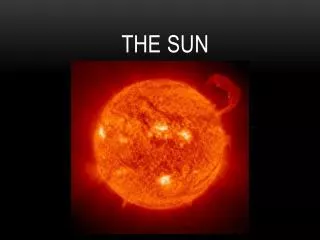
WHAT IS THE SUN? • Centre of the Solar System • A foci for all planets in the Solar System • A yellow star • Luminous • Composed of plasma (an ionized gas) made mostly of hydrogen and helium. http://www.bnsc.gov.uk/assets/channels/education/ae/solar.gif
OUR STAR’s SIZE • 1,400,000,000 m diameter • The Sun could hold 1.3 million Earth’s! http://www.answersingenesis.org/assets/images/articles/tba/chapter-one/sun-moon-earth.jpg
THE SUN’S MASS • 750 times the mass of all of the Solar System’s planets put together • Between 98% and 99% of the Solar System’s mass • 332,830 times the mass of Earth! • 1.989 x 1030 kg (1,989,000,000,000,000,000,000,000,000,000kg)
OUR STAR – KEY FACTS • DENSITY: 1410 kg/m3 • At the Sun’s centre, the density is more than 150 times that of water! • TEMPERATURE: • Average temperature: Approximately 6270Kelvin • 6000°C • This is the same temperature as the Earth’s core! • ATMOSPHERE: • Made up of immense clouds of glowing gas • Stretches far into space • Can only be seen during total solar eclipses
OUR STAR • Surface temp = 5500°C • Core temp = 15 million°C http://www.rise.org.au/info/Res/sun/image004.jpg
KEY FACTS • The obliquity (or axial tilt) of the Sun is 7.25° http://en.wikipedia.org/wiki/File:AxialTiltObliquity.png
KEY FACTS • 1) The Sun has no moons or rings. • 2) The Sun has natural satellites – the planets, dwarf planets, and smaller celestial bodies • 3) Distance from Earth: 1 AU • 4) The closest planet is Mercury • 5) The farthest planet is Neptune
Classifying the Sun • 1) “Jovian” – made of gases • 2) “Classical” – can be seen with the naked eye • Scientists used to think the Sun was a planet!
GRAVITATIONAL PULL • Acceleration due to gravity = 274 m/s2 • Compared to Earth’s 9.81 m/s2 http://www.kudzuacres.com/wwow/lessons/weather/oceansurface_files/image003.jpg
GRAVITATIONAL PULL • Fg=mg • Earth Sun • Fg = 70 x 9.81 Fg = 70 x 274 = 686.7 N = 19,180 N
OUR STAR – TIMES! • The core rotates at the same rate but the outer parts of the Sun do not! • 34 Earth days to rotate at Poles • 25 Earth days to rotate at Equator • There is no period of revolution… http://www.lcsd.gov.hk/CE/Museum/Space/EducationResource/Universe/framed_e/lecture/ch11/imgs/rotation.gif
OUR STAR – TIMES! • Our Sun is estimated to be approximately 4.5 billion years old. • It should last another 5 billion years. • Made initially from a cloud of dust. • Matter fell inwards, creating heat, eventually causing nuclear fusion and producing its own light and energy.
BRIGHTNESS • −26.74 visual magnitude • Brightest object in sky from Earth
STUDYING THE SUN • Ancient civilizations studied the sky and stars • Many had Sun gods • Amaterasu (Japan) • Helios, Apollo (Greek) • Freyr, Sol (Norse) • Huitzilopochtli (Aztec) • Inti (Inca) • Liza (West African) • Re/Ra (Egyptian)
STUDYING THE SUN • In 1609 Galileo built his first telescope • He saw Sunspots http://www.telescope1609.com/images/GalileosTelescope.jpg http://www.norcalblogs.com/watts/images/sunspots_earth_size_big.jpg
STUDYING THE SUN • 1960’s • PIONEER 5 to 9 • Orbited the sun • Solar wind • Solar flares • Magnetic fields http://abyss.uoregon.edu/~js/images/pioneer6.jpg
STUDYING THE SUN • 1974 & 1976 • HELIOS • High-velocity passes close to Sun’s surface • Solar wind • Magnetic field http://thelongestlistofthelongeststuffatthelongestdomainnameatlonglast.com/images4/helios.JPG
STUDYING THE SUN • 1980 • SOLAR MAXIMUM MISSION • X-rays • Gamma rays • Ultraviolet radiation • From flares and sunspots http://library01.gsfc.nasa.gov/gdprojs/images/smmrepair.jpg
STUDYING THE SUN • 1990 • ULYSSES • 1st polar orbiting probe • Still in operation • “Fly by” http://science.nasa.gov/headlines/y2008/images/northpole/Ulysses_spacecraft.jpg
STUDYING THE SUN • 1991 • YOHKOH • Earth-orbiting satellite observed high-energy radiation http://heasarc.gsfc.nasa.gov/Images/objects/heapow/solar_system/yohkoh_solar_cycle.jpg
STUDYING THE SUN • 1995 • SOHO • Studies the Sun’s interior and surface http://msnbcmedia3.msn.com/j/msnbc/Components/Photos/051129/051129_soho_hmed2p.h2.jpg
STUDYING THE SUN • 1998 • TRACE • Studies the Corona http://library01.gsfc.nasa.gov/gdprojs/images/trace.jpg
SUN MYTHS • “What if the sun collapses into a black hole? • Bad Astronomy: If the Sun collapses into a black hole, the Earth and all the other planets will get sucked in. • Good astronomy: If the Sun were to collapse into a black hole, we would feel no difference in the gravity as measured at the Earth. “ (Note the quotations as I have copied this!!!) http://www.badastronomy.com/bad/misc/black_hole_sun.html
Sources • http://z.about.com/d/space/1/5/Y/Q/sun_tour.jpg • www.answers.com/topic/hertzsprung-russell-diagram • http://www.answersingenesis.org/assets/images/articles/tba/chapter-one/sun-moon-earth.jpg • http://www.astro.washington.edu/labs/clearinghouse/labs/Propsun/images/chang_sun2.gif • http://hometown.aol.com/falconmaster29/downloads/SolarFlare.jpg • http://www.nasa.gov/images/content/171925main_heliolayers_label_516.jpg • http://www.space.gc.ca/asc/img/trans_mass_n_weight.jpg • http://www.geocities.com/ominaga2/amaterasu_classic2.jpg • http://www.maicar.com/GML/000Free/000Apollo/image/apollo3837.jpg • http://www.hurstwic.org/history/articles/mythology/myths/pix/freyr.jpg • http://www.class.uh.edu/courses/engl3396/jtchris2/Huitzilopochtli.jpg • http://www.unique-southamerica-travel-experience.com/images/inti-copia.jpg • http://www.telescope1609.com/images/GalileosTelescope.jpg • http://astronomy.neatherd.org/Swedish%20sunspots1.jpg • http://abyss.uoregon.edu/~js/images/pioneer6.jpg • http://www.deutsches-museum.de/uploads/pics/helioskl_05.jpg • http://library01.gsfc.nasa.gov/gdprojs/images/smmrepair.jpg • http://www.sflorg.com/missionnews/ulysses/images/immn081707_01_01.jpg • http://msnbcmedia3.msn.com/j/msnbc/Components/Photos/051129/051129_soho_hmed2p.h2.jpg • http://library01.gsfc.nasa.gov/gdprojs/images/trace.jpg • http://en.wikipedia.org/wiki/Sun • Information from “Universe: the definitive visual guide” senior editor: Peter Frances