Download
1 / 68
680 likes | 857 Views
This chapter explores the three main types of muscle tissue: skeletal, cardiac, and smooth. Skeletal muscle, accounting for 40-50% of body weight, is voluntary and facilitates movement and stabilization. Cardiac muscle, found only in the heart, is involuntary and maintains blood flow. Smooth muscle is located in walls of hollow organs, regulating flow and movement within the digestive and reproductive systems. The chapter also covers muscle histology, contraction mechanisms, neuromuscular interaction, and muscle metabolism, highlighting the crucial roles these tissues play in the human body.

E N D
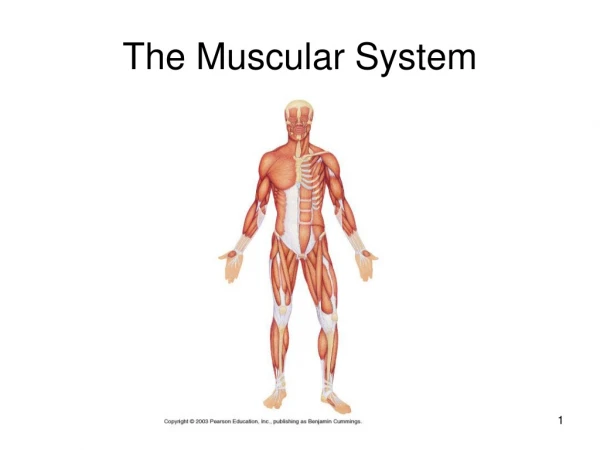
The Muscular System Chapter 8
Types of muscle & function • Skeletal- 40-50% of total body weight- voluntary • mostly movement of bone & body parts • Stabilizing body positions • Cardiac- only in heart- involuntary • Heart only • Develops pressure for arterial blood flow • Smooth- grouped in walls of hollow organs • Sphincters regulate flow in tubes • Maintain diameter of tubes • Move material in GI tract and reproductive organs
Muscle Functions • Produce body movements • Stabilize body positions • Regulate organ volume • Moving substances internally • Producing heat
Skeletal Muscle Tissue • Muscle includes: muscle fibers, connective tissue, nerves & blood vessels • Wrapped in Epimysium • Perimysium surrounds fiber bundles called fascicles • Endomysium surrounds each individual fiber
Skeletal Muscle Tissue • Well-supplied with blood vessels and nerves • Terminal of a neuron on each muscle fiber
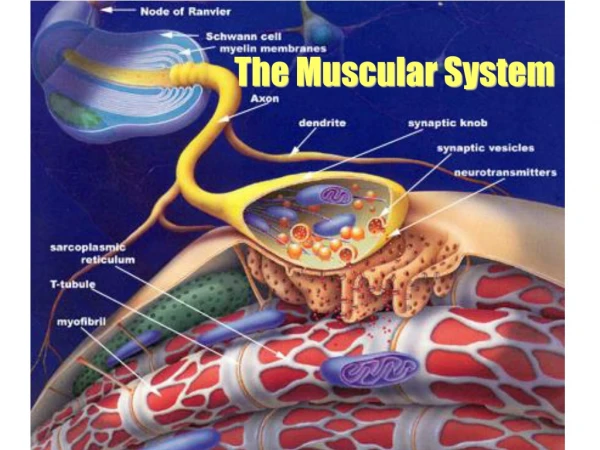
Muscle Histology • elongated cylindrical cells = muscle fibers • plasma membrane = sarcolemma • Transverse (T- tubules) tunnel from surface to center of each fiber • Multiple nuclei lie near surface • Cytoplasm = sarcoplasm
Muscle histology (cont.) • Throughout sarcoplasm is sarcoplasmic reticulum • Stores Calcium ions • Sarcoplasm contains myoglobin • Red pigmented protein related to Hemoglobin that carries oxygen • Along entire length are myofibrils • Myofibrils made of protein filaments • Come in thick and thin filaments
Sarcomere • Filaments overlap in repeating patterns • Unit structure is called sarcomere • Separated by Z-discs • Darker area = A-band associated with thick filaments • H-zone has no thin filaments • I-band has thin filaments no thick filaments
Functional Structure • Thick filament (myosin) has moveable heads • Thin filaments (actin) are anchored to Z-discs • Contain myosin binding sites for myosin head • Also contain tropomyosin & troponin • Tropomyosin blocks myosin binding site at rest
Sliding Filament Mechanism • During contraction myosin heads bind actin sites • Pull and slide actin molecules (and Z-discs) toward H-zone • I-bands and H-zones narrow • Sliding generates force and shortens sarcomeres and thus fibers.
Neuromuscular Interaction • Nerve signal triggers muscle action potential • Delivered by motor neuron • One neuron can trigger 1 or more fibers at the same time • Neuron plus triggered fibers = motor unit
Neuromuscular Junction • neuronal ending to muscle fiber = Neuromuscular junction • Synaptic end bulbs (at neuron terminal) • Release neurotransmitter • Muscular area = Motor end plate • Between is synaptic cleft
Action at NMJ • Release of acetylcholine (ACh) • Diffuses across cleft 2.Activation of ACh receptors 3. Generation of Muscle Action Potential Repeats with each neuronal action potential 4. Breakdown of ACh
Contraction Trigger • Muscle action potential=> Ca2+ release from Sacroplasmic Reticulum (SR) • Ca2+ binds to troponin => • Moves tropomyosin off actin sites => • Myosin binds & starts cycle
Contraction Cycle • Myosin binds to actin & releases phosphate group (Forming crossbridges) • Crossbridge swivels releasing ADP & shortening sarcomere (Power stroke) • ATP binds to Myosin => release of myosin from actin • ATP broken down to ADP & Pi => activates myosin head to bind and start again • Repeats as long as Ca2+ concentration is high
Relaxation • Breakdown of Ach to stop muscle Action potentials • Ca2+ ions transported back into SR lowering concentration=> • This takes ATP • tropomyosin covers actin binding sites
Muscle Tone • Even at rest some motor neuron activity occurs = Muscle Tone • If nerves are cut fiber becomes flaccid (very limp)
Metabolism • Rapid changes from very low ATP consumption to high levels of consumption • Creatine phosphate (high energy store) • Fast & good for ~ 15 sec
Glycolysis • Break down glucose to 2 pyruvates getting 2 ATPs • If insufficient mitochondria or oxygen pyruvate => lactic acid • Get about 30-40 seconds more at max.
Aerobic Cellular Respiration • Production of ATP in mitochondria • Requires oxygen and carbon substrate • Produces CO2 and H2O and heat.
Fatigue • Inability to contract forcefully after prolonged activity • Limiting factors can include: • Ca2+ • Creatine Phosphate • Oxygen • Build up of acid • Neuronal failure
Oxygen Use After Exercise • Convert lactic acid back to glucose in liver • Resynthesize Creatine Phosphate and ATP • Replace oxygen removed from myoglobin
Control of Muscle Contraction • Single Action Potential(AP) =>twitch • Smaller than maximum muscle force • Total tension of fiber depends on frequency of APs (number/second) • Require wave summation • Maximum = tetanus • Total tension of muscle depends on number of fibers contracting in unison • Increasing numbers = Motor unit recruitment
Fiber types • Slow oxidative (SO)- small diameter & red • large amounts of myoglobin and mitochondria • ATP production primarily oxidative • Fatigue resistant- • Fast oxidative- glycolytic (FOG) • Large diameter = many myofibrils • Many mitochondria and high glycolytic capacity • Fast glycolytic fibers (FG) • white, fast & powerful and fast fatiguing • For strong, short term use
Recruitment • Muscle contractions only use the fibers required for the work • Recruited in order: SO=>FOG=>FG • if force is constant and the muscle shortens = Isotonic Contraction • If length is constant and the force varies = Isometric Contraction • The latter is often a postural muscle activity
Effects of Exercise • SO/FG fiber ratio genetically determined • High FG => sprinters • High SO=> marathoners • Endurance exercise gives FG=> FOG • Increased diameter and numbers of mitochondria • Strength exercise increases size & strength of FG fibers
Cardiac Muscle • Striated, short fibers and branched • Single central nucleus; Cells joined by gap junctions & desmosomes • Thickened joint area called intercalated discs • Some cardiac muscles generate own AP- autorhythmicity • Involuntary
Cardiac muscle • No nerve- internal pacemaker • Ca2+- from S.R. and extracellular space • separate cells with gap junctions -> electrical connections
Smooth muscle • Involuntary • In internal organs • Filaments not regular so not striated • Visceral (single unit) type or • Form sheets and are autorhythmic • Contract as a unit • Multi-unit type- • each has own nerve and can contract independently
Smooth Muscle • Graded contractions and slow responses • Often sustain long term tone • Often triggered by autonomic nerves • modulated chemically, nerves, by mechanical events (stretching)
Aging • Like bone there is a slow progressive loss of skeletal muscle mass • Relative number of SO fibers tends to increase
Movement • Move one bone relative to another • Origin => most stationary end • Location where the tendon attaches • Insertion => the most mobile end • Location where tendon inserts • Action => the motion or function of the muscle
Movement (cont.) • Generally arranged in opposing pairs • Flexors- extensors; abductors- adductors • The major actor = Prime mover or agonist • The one with opposite effect = antagonist • Synergists- help prime mover • Fixators- stabilize origin of prime mover • Role of muscle varies with motion