Building a Strong PreK-3 System: 10 Essential Steps for Community Impact
Discover 10 crucial steps to establish a successful PreK-3 educational system that effectively meets the needs of families and children. This guide emphasizes the importance of community involvement, shared goals, and strong leadership. From assessing community needs and building common interests to connecting early childhood environments and aligning educational standards, each step provides actionable insights to improve educational outcomes. Celebrate successes, foster collaboration, and ensure sustainability in your efforts to make a lasting difference in early childhood education.

Building a Strong PreK-3 System: 10 Essential Steps for Community Impact
E N D
Presentation Transcript
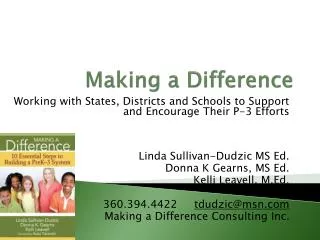
Making a Difference 10 Essential Steps to Building a PreK-3 System Linda Sullivan-Dudzic (360) 394-4422 tdudzic@msn.com Donna Gearns (360) 536-6230 dgearns@gmail.com & Kelli Leavell leavell@wavecable.com
Step 1: Establish Need and Common InterestWhere is your community?Do you have a shared passion, PreK-3?Do you celebrate your successes? Are you able to talk about the tough issues?
Step 1: Establish Need and Common Interest • In the world of Early Childhood are you Overwhelmed by the needs of families and children?
PreK • The opportunity to attend a quality PreK class makes a child 40 percent less likely to need special education, 40 percent less likely to repeat a grade, and twice as likely to attend college.” (Patrick, 2007)
K-12 System • “Our nation pays a significant price for inadequate education in terms of income, health car, crime, and dependence on public assistance (Levin & Belfield, 2007) • 2 out of every 5 students receiving special education in the U.S. were identified because of difficulties in learning to read (Ed Pubs 2002)
Double Jeopardy: How Third-Grade Reading Skills and Poverty Influence High School Graduation Hernandez, D. J. (2011). Double Jeopardy: How Third-Grade Reading Skills and Poverty Influence High School Graduation. New York: The Annie E. Casey Foundation and The Center for Demographic Analysis, University of Albany, State University of New York.
Step 1: Work together to Establish Need and Common Interest • Prioritize your efforts! • Share your passion • What are you working on and why • Acknowledge that you are doing it all AND focus your efforts.!
Step 1: Your Turn What are your community Needs and commitment PreK-3? • What does your Trend data tell you? • Current Needs of your families? • Where do your families seek excellence for their children? • Where do families go for information? • Have you (together) defined excellence?
Step 2: Connect with Early Childhood Learning Environments and Step 3: Develop a Leadership Group
Think about what you are doing that is more than connecting and more than activities. * • Real Life stories to provide Encouragement and Hope to illustrate the first three steps . . .
More of this. . . Shared resources For staff and Families More options Quality education Strong foundation Within and outside the school
Common Goals • Shared Language • Common Curriculum
Together we defined what quality looks like. . . . Beyond the Rhetoric – Susan Neumann “Task predicts performance”- Elmore
More about the Leadership Group and Beyond Bremerton : Step 3
Step 3: Leadership Group: Roles and Responsibilities Build strong PreK-3 system of support Examine data, refine and adjust Alignment Instructional Practices Professional Development Shared resources Celebrations of success and PR Build capacity and sustainability
Step 3 Leadership Group . . . Who is leading PreK-3 in your District and Community? • Central Office? • Budget Department? • Personnel?
Your Turn using Step 2 and 3 Locate your Partners & who is on your PreK-3 Leadership Group * • Are you reaching all prior to kindergarten in your community? • Is your group a source of encouragement? • Professional Development? • Current research? • Are you on the same page and moving forward to help children and families?
Step 4: High Quality Professional Development Step 5: Connect and Align High Quality PreK to K Step 6: Maximize the Benefits of FDK
Step 4: Your Turn: where are you on Providing PreK-3 staff with the Tools they Want and Need ? • Conversation: How are you selecting Professional Development? • The dangers of “spraying” • How do you know if it’s working?
Connecting is more than transition Activities
Step 5: Connect and Align . . . • Key components • Assessment Loop • Strength Based • Respectful • Celebration • How many more can we reach?
Not every Teacher is an Early Childhood Teacher • Quality counts!
“Friendly Accountability “ • What the day looks like! Learning Walks
Step 6 Maximize learning in full-day kindergarten and beyond
Step 7: Align and Connect a Strong Full Day Kindergarten with Grades 1-3 • Connecting full day kindergarten to grades 1-3 • Align your K-3 standards • Align your assessment and information loop • Align curriculum and instructional practices • Tiered systems • Connect and align resources • AND Step 8: Conquer the Fade Out
How are you doing in your community? The important work of PreK, K and 1, 2 and 3 • Horizontal • Vertical • Temporal
Your Turn. . .Celebrate where you are at and make a plan for next steps*
Step 9: Create a Sustainable System of Instructional Support –the afternoon