Download
1 / 20
200 likes | 307 Views
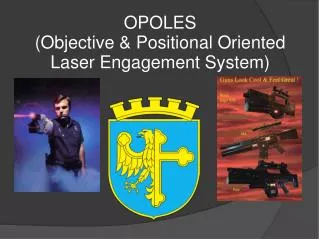
The OPOLES (Objective & Positional Oriented Laser Engagement System) is an advanced, modular laser tagging system designed to enhance gameplay and tracking features. It integrates sophisticated components such as optical receivers and GPS for projectile calculations and player tracking. With features like real-time scoring, point-to-point data transmission, compatibility modes, and interactive game functions (e.g., player hunting, respawn points), it offers a rich and engaging gaming experience. Designed for safety and low power consumption, it is versatile and easy to upgrade.

E N D
OPOLES (Objective & Positional Oriented Laser Engagement System)
Objective • To create a highly modular base laser tag system. • A feature rich system • Expands on the functionality of the current systems
Systems Diagram Optical Receiver GPS Expandable User I/O (Optional) CPU RF Link Primary User I/O Memory Optical Transmitter
GPS • Global Positioning System • Standalone chip that streams the chips location. • To Be used for: • Projectile Calculations • Ballistics • Blast Damage • Player Tracking • Interactive Game Play Features: • Positional Respawn • Capture/Reach Location • Hunt Player (Radar-ish)
GPS Block DSP/Micro Main board Antenna GPS Chip
RF Link • Radio Frequency Communication. • To Be Used For: • Upload Game Rules • Real Time Scoring • Player Tracking • For display to observers • For Game Play Options (hunt player, captured flag location, ect.)
RF Block DSP/Micro Main board Antenna Transceiver
Optical Transmitter • Transmit point to point line of sight data. • Used For: • Shooting target • Transferring upgrades (health, ammo) • Other optical communications • Set game options in Compatibility modes.
Optical Receiver • Receive Optically transmitted signals. • Used For: • Receiving shots from enemies. • Receiving point to point upgrades (health, ammo, ect.) • Other optical communications • Set game options in Compatibility modes.
Optical Block Receivers (40KHz and 56KHz) Main Board Optical Transmitter (40KHz and 56KHz)
Memory • Provide storage for: • Software • Compatibility modes • Miles, Fragtag, WOW, LTTO • Game types • Capture the Location • Free For All • Player Hunting • ect. • Game Data • Player Data
Primary I/O • Display (LCD/OLED/ect) • Trigger • Force Feedback • Controls (Keypad/Buttons) • Used for navigating software features. • Team color selecting LEDs • Tell a player which sensors are active • Tell players which team a player is aligned. • Other game specific options
Secondary I/O • Future Upgrades • Ammo, Health, Engineering Boxes • Secondary weapons (Pistols, grenade programing) • ect.
Safety • Low voltage/ Low current system will be fairly harmless to users. • Low power IR light is harmless. • You can’t prove that RF signals are harmful so HAH! • Common sense.
Risks • Unable to get parts. • Price of adding feature is too expensive. • Complexity of feature is too hard to implement in a semester time frame. • Scheduling issues.
Contingency • Modular system eliminates need some compatibility issues since we will have a communication protocol for between components. • Modular system we can drop a module without having to completely redesign our system. • If a system can’t be implemented to complexity we can remove that module for the time being. • SVN software/email/weekly meetings.
Who and What • John: • Main board • Communications • TJ: • RF link • GPS • Jen-Yuan: • Power supply • Circuit Modeling • Richard: • Coding • Documentation