Overview of WAN Technologies: X.25, Frame Relay, ATM, DSL, and More
140 likes | 289 Views
This article provides a comprehensive overview of various Wide Area Network (WAN) technologies, including X.25, Frame Relay, ATM, DSL, and cable modems. X.25 operates with packet-switched networks using virtual circuits, while Frame Relay improves efficiency over X.25 and focuses on end-to-end control. ATM employs fixed-size packets for seamless communication across networks. DSL offers high-speed internet via telephone lines, while cable modems facilitate data transfer through coaxial cables. We also explore microwave links and VSAT for satellite communication, detailing bandwidth options and operational modes.


Overview of WAN Technologies: X.25, Frame Relay, ATM, DSL, and More
E N D
Presentation Transcript
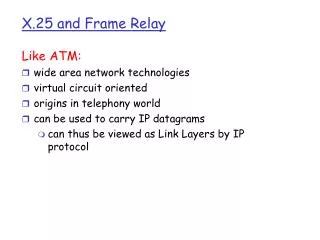
WAN Technologies X.25 • Packet switched Network consisting of X.25 switches. • X.25 is a connection oriented protocol (Virtual Circuits). • End nodes are identified by an X .25 address. • Typical bandwidth offered is 2.4/9.6 kbps. • IP networks interface with X .25 through IP- X.25 routers.
WAN Technologies X.25 and Virtual Circuits
WAN Technologies Frame Relay • Designed to be more efficient than X.25 • Developed before ATM • Call control carried in separate logical connection • No hop by hop error or flow control • End to end flow and error control (if used) are done by higher layer • Single user data frame sent from source to destination and ACK (from higher layer) sent back • Two type of Virtual Circuits defined • Permanent virtual circuits (PVCs) • Switched virtual circuits (SVCs)
WAN Technologies ATM • Small fixed size packets of 53 bytes, called cells, are used for transferring information. • Each cell has 5 bytes of header and 48 bytes of payload for user information. • Connection oriented protocol. • A virtual Circuit is established between the communicating nodes before data transfer takes place. • Can be seamlessly used in LANs and WANs. • Almost unlimited scalability. • Provides quality of service guaranties.
WAN Technologies Digital Subscriber Line (DSL) • Digital Subscriber Line (DSL) uses the Ordinary Telephone line and is an always-on technology. This means there is no need to dial up each time to connect to the Internet. • Because DSL is highly dependent upon noise levels, a subscriber cannot be any more than 5.5 kilometers (2-3 miles) from the DSL Exchange • Service can be symmetric, in which downstream and upstream speeds are identical, or asymmetric in which downstream speed is faster than upstream speed. • DSL comes in several varieties: • Asymmetric DSL (ADSL) • High Data Rate DSL (HDSL) • Symmetric DSL (SDSL) • Very High Data Rate DSL (VDSL)
WAN Technologies ADSL
WAN Technologies Cable Modems • The cable modem connects a computer to the cable company network through the same coaxial cabling that feeds cable TV (CATV) signals to a television set. • Uses Cable Modem at Home End and CMTS (Cable Modem Termination System) at Head End. • Characteristics: • Shared bandwidth technology • 10 Mbps to 30 Mbps downstream • 128Kbps-3 Mbps upstream • Maximum Distance from provider to customer site: 30 miles
WAN Technologies Cable Modems
WAN Technologies Point-to-Point Microwave Link MICROWAVE LINK Network RFModem Router Router RFModem ISP Network CUSTOMER PREMISES ISP PREMISES
WAN Technologies Point-to-Point Microwave Link • Typically 80-100 MHz Band or 5 GHz Radio Link band • 2.4 GHz WiFi links are becoming popular • Requires Line of Sight
WAN Technologies VSAT • Very Small Aperture Terminal (VSAT) provide communication between two nodes through a powerful Earth station called a Hub. • If two terminals want to communicate, they send their messages to the satellite, which sends it to the Hub and the Hub then broadcasts the message through the satellite. • Typical Bandwidth offered is 9.6/19.2/32/64/128/256/512 Kbps. • Operating modes are TDM/TDMA, SCPC PAMA & DAMA
WAN Technologies VSAT • Each satellite sends and receives over two bands • Uplink: From the earth to the satellite • Downlink: From the satellite to the earth • Satellite frequency bands Band Downlink Uplink C 3.7-4.2 GHz 5.925-6.425 GHz Ku 11.7-12.2 GHz 14-14.5 GHz • Ku-band based networks, are used primarily in Europe and North America and utilize the smaller sizes of VSAT antennas. • C-band, used extensively in Asia, Africa and Latin America, require larger antenna.