Statistical Mechanics of Jammed Particulate Matter in Granular and Colloidal Systems
This research focuses on studying the statistical mechanics of jammed particulate matter using simulations and theoretical approaches. By applying slow shear flow to jammed systems of grains, we measure mobility and diffusivity to determine an effective temperature. We also explore the "small-world" network topology formed by jammed configurations and their transition states, drawing parallels with complex networks like the internet and protein interactions. Our work not only advances scientific understanding but also fosters an inclusive educational environment for diverse students.

Statistical Mechanics of Jammed Particulate Matter in Granular and Colloidal Systems
E N D
Presentation Transcript
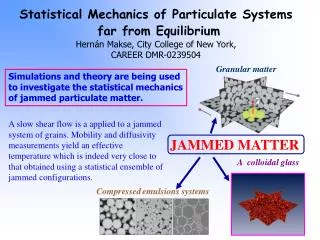
Granular matter A colloidal glass Compressedemulsions systems Statistical Mechanics of Particulate Systems far from EquilibriumHernán Makse, City College of New York, CAREER DMR-0239504 Simulations and theory are being used to investigate the statistical mechanics of jammed particulate matter. A slow shear flow is a applied to a jammed system of grains. Mobility and diffusivity measurements yield an effective temperature which is indeed very close to that obtained using a statistical ensemble of jammed configurations. JAMMED MATTER
Statistical Mechanics of Particulate Systems far from EquilibriumHernán Makse, City College of New York, CAREER DMR-0239504 The network formed by the jammed configurations and their transition states is a “small-world” network with a scale-invariant topology. Each node in the network is a jammed state. The nodes are linked if there is transition state between them. The network has the same topological properties as other complex networks such as WWW, Internet, protein-protein interaction networks, and sociological networks. First-order saddle Transition state Jammed configuration Jammed configuration
Statistical Mechanics of Particulate Systems far from EquilibriumHernán Makse, City College of New York, CAREER DMR-0239504 Education • Students: two graduate students and four undergraduate students. • International collaborations: one exchange student from Fortaleza, Brazil, and one from ENS, France. International collaborations with Prof. Shlomo Havlin (Israel), Dr. Jorge Kurchan, (Paris) and Prof. Sam Edwards (UK). • Attraction and retention of minority students: 3 undergraduate minority students working in the lab from Physics, Chemical and Mechanical Engineering reflecting the interdisciplinary nature of our work. • Dissemination to a broader audience: Why does this sandstone from Petra have stripes? See details at: http://www.seed.slb.com/en/scictr/watch/stratifi/index.htm • Translation of the web content to spanish “Porque algunas areniscas presentan franjas?” At: http://www.seed.slb.com/es/index.htm • Curriculum development: New graduate course: Granular Matter. Students are introduced to research earlier in their careers: a student project comparing experiments and simulation of sandpiles has been recently published in J. Stat. Phys. 3, 1-8 (2004).