Mastering Persuasion in Public Speaking: Strategies for Effective Communication
In this comprehensive guide, Professor Doug Binsfeld delves into the art of persuasion in public speaking. Learn the essential methods and tactics that persuade listeners, including the role of evidence and reasoning. Discover four critical tips for using evidence effectively, the importance of emotional appeal, and how to engage your audience in a mental give-and-take. Explore types of reasoning and various organizational patterns, equipping yourself to address questions of fact, value, and policy. Transform your public speaking skills and influence your audience convincingly!

Mastering Persuasion in Public Speaking: Strategies for Effective Communication
E N D
Presentation Transcript
Persuasive Speeches Professor Doug Binsfeld Introduction to Public Speaking
Interest in the Methods of Persuasion • Strategies and Tactics • Why Listeners are persuaded by a speaker
Role of Evidence • What does Evidence Consist of? • Evidence Support • Four Tips • Use Specific Evidence • Use Novel Evidence • Credible Sources • Make Evidence Clear
Reasoning in Persuasion • Reasoning is Drawing a Conclusion Based on Evidence • Two Major Concerns • Sound Reasoning • Get Listeners to Agree • Four Types of Reasoning • Specific Instances • Reasoning from Principle • Casual Reasoning • Analogical Reasoning
Emotions in Persuasion • Emotional Appeals • Persuasion often Requires Emotional Appeal • Three Ways • Emotionally Charged Language • Vivid Examples • Sincerity and Conviction
Psychological Process • Persuasion Occurs in Situations where disagreement exists • Persuasion is the Most Complex and Challenging Type of Public Speaking • Listeners have to engage in a Mental Give and Take
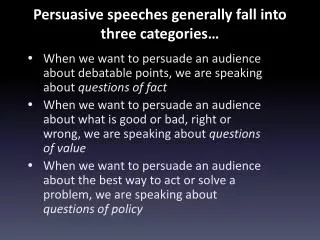
Questions of Fact • Speakers Seek to Persuade an Audience to Accept their Point of View. • Some Can be Answered with Certainty • Some Cannot be Answered with Certainty
Questions of Value • Require Judgements based on a person’s belief • Speaker Needs to Justify Her/His Value
Questions of Policy • Deal with Specific Courses of Action • Two Types • Passive Agreement • Immediate Action • Three Basic Issues • Need • Plan • Practicality
Four Patterns of Organization • Problem-Solution • Problem-Cause-Solution • Comparative Advantages • Monroe’s Motivated Sequence