Enhancing Inversion Techniques: Addressing Confidence Levels and Systematic Issues
Inversion presents one of its biggest challenges in the confidence level of features within solutions. Inverters must intensify their efforts to uncover subtle signatures in flows and structures. This includes addressing systematic errors, improving assessments of input errors, and considering error correlations more thoroughly. Additional steps involve refining surface term representations and integrating high-l data while acknowledging how frequencies are measured. The reconciliation of linear and non-linear methods will also lead to improved kernels for asphericities and a better understanding of near-surface complexities.

Enhancing Inversion Techniques: Addressing Confidence Levels and Systematic Issues
E N D
Presentation Transcript
Real? Real? Inversions
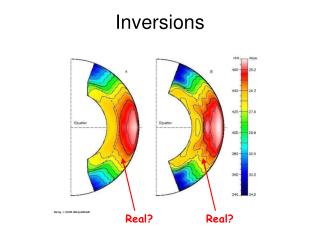
Real? One of the biggest challenges for inversion is to take seriously the issue of what is the level of confidence in features in the solution
Issues • It’s time inverters started working harder – discoveries are to be made in the subtle signatures in flows and structure. • Beat down the systematics • Make better assessment of input errors • Properly take into account error correlations
Issues • It’s time inverters started working harder – discoveries are to be made in the subtle signatures in flows and structure. • Beat down the systematics • Make better assessment of input errors • Properly take into account error correlations • Need to do better with near-surface • Incorporate high-l data • Kernels need to take into account the way freqs are measured • How to incorporate local helioseismic data: 3D models in C.Z. ? • Make higher-order representations of “surface term”
Issues • It’s time inverters started working harder – discoveries are to be made in the subtle signatures in flows and structure. • Beat down the systematics • Make better assessment of input errors • Properly take into account error correlations • Need to do better with near-surface • Incorporate high-l data • Kernels need to take into account the way freqs are measured • How to incorporate local helioseismic data: 3D models in C.Z. ? • Make higher-order representations of “surface term” • Reconcile linear and non-linear (e.g. Vorontsov) methods
Issues • It’s time inverters started working harder – discoveries are to be made in the subtle signatures in flows and structure. • Beat down the systematics • Make better assessment of input errors • Properly take into account error correlations • Need to do better with near-surface • Incorporate high-l data • Kernels need to take into account the way freqs are measured • How to incorporate local helioseismic data: 3D models in C.Z. ? • Make higher-order representations of “surface term” • Reconcile linear and non-linear (e.g. Vorontsov) methods • Improve kernels for asphericities
Issues • It’s time inverters started working harder – discoveries are to be made in the subtle signatures in flows and structure. • Beat down the systematics • Make better assessment of input errors • Properly take into account error correlations • Need to do better with near-surface • Incorporate high-l data • Kernels need to take into account the way freqs are measured • How to incorporate local helioseismic data: 3D models in C.Z. ? • Make higher-order representations of “surface term” • Reconcile linear and non-linear (e.g. Vorontsov) methods • Improve kernels for asphericities • Test whole inference procedures with data from C.Z. simulations