PF Quiz for Web
370 likes | 372 Views
Perspectives on Prairie Restoration: Asking Why?


PF Quiz for Web
E N D
Presentation Transcript
Perspectives on Prairie Restoration: Asking Why? Shawn Schottler, Senior Scientist. St. Croix Watershed Research Station Program of the Science Museum of Minnesota
Why do we do the things we do? Challenging us to think about restoration? Ask Why…!
Intellectual Disclaimer The ideas presented today do not necessarily reflect the views of PF, or any agencies. The content in this presentation is the result of 24 years of mistakes. All concepts promoted in this talk should be questioned and thought about before being accepted. Answers shown may be “correct” today but could also change. It is the sole responsibility of the audience to think before they repeat what is said. The presenter reserves the right to change his viewpoint as he gets older.
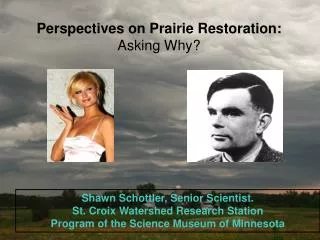
Paris Hilton: Model Purpose: Be Beautiful Prairies are suppose to “do something” Purpose = ecosystem (habitat) =beautiful If it serves its purpose it is beautiful Frank Lloyd Wright Landscaping/Flower Garden vs. Prairie Restoration Beautiful. Yes! Beautiful. ? Alan Turing: Broke German code WWII Invented computer Purpose: Do Math,
A Quiz: “Why do we do the things we do?” I didn’t plant it, I don’t want it: Friends and Foes Invasives Bad Bad Brome Competition Ask Why. Challenging us to think about restoration?
Question 1 I have a nice stand of Indian Grass and Big Blue that I planted as pheasant habitat. I have some Canada Goldenrod invading this field, how should I get rid of it? “I didn’t plant it, I don’t want it” 2,4D 2,4D plus Roundup Transline Coffee
Coffee anada Goldenrod
Objective: Grow Pheasants What do pheasant chicks eat for their first two months? Protein--Insects What pollinates grass ? What pollinates Canada Goldenrod ? Solution: In the morning standing at the edge of the field 1 cup of coffee for 30 days Repeat these magic words “I like Canada goldenrod, it came in for free!” Think Habitat
Question 2: I have a nice a stand of Switch grass that I planted as pheasant habitat. I have a few Canada Thistles in this field, how should I get rid of them? Invasives Spot spray 2,4D 2,4D & Roundup Vodka Spot Spray Transline All the above Think habitat
Enjoy in Moderation Vodka like thistles: Good, in Moderation Thistle excellent nectar plant for insects. Provides diversity and protein in a grass field Why do you hate thistles ? What was your objective…? Thistles (and other invasive) are only bad when in excess…
Question 3 I have field of brome grass next to my other restoration, what’s the easiest way to convert this one to native tall-grasses also? Bad, Bad Brome Memories Coffee Vodka IH 656 and 4 bottom plow Burn, burn, burn Inter-seed with cord grass D and E A, B, and C B, C and maybe E Think habitat structure
Comparing Different Habitat--A new study site Austin MN-- in partnership with Mower Co. Pheasants Forever Chapter
Cool Season Grass a.k.a. Brome Warm Season Grass High Diversity Tall, High Div. High Diversity Cool Season Grass Cool Season Grass Warm Season Grass Tall, High Div. Warm Season Grass High Diversity High Diversity Tall, High Div. Cool Season Grass Warm Season Grass High Diversity
Cool Season Grass Patches (low floristic diversity) Almost Exclusively Cool Season Grass, Short, (Brome) Songbird Habitat Preferences With side-by-side options Bobolinks Meadow Larks Henslow Sparrow
It’s Not Native I have field of Brome Grass next to my other restoration, what’s the easiest way to convert this one to native tall-grasses also? Memories Coffee Vodka IH 656 and 4 bottom plow Burn, burn, burn Inter-seed with cord grass E and F A, B, and C B, C and maybe E
Coffee With coffee, in the morning, repeat after me (“I like brome”) c. Vodka Only good in moderation. (a little brome is good) a. Memories Where did you see Meadow larks as a kid? Short grass meadows, alfalfa, pastures. (bromeish) Until we create native habitat that has a short, cool season structure…brome is not all bad!
Question 4 I have 40 acres. I want to maximize my habitat value, what’s the minimum number of species I should plant? Diversity and Habitat Two 12 24 More than a case
Side-by-side habitat comparisons North 1/4 acre WSG MP >80% Warm Season Grass, typical CRP, 6 plant species MP CSG CSG >70% Cool Season Grass, (non-native) 6 plant species MP WSG MP Mixed Prairie planting, high diversity 45 plant species - 30 acre site, enrolled in CRP 1986
Side-by-side Experimental Site Compare pheasant and songbird nesting preferences, and small mammal abundances in side- by-side plots CSG <10% forbs ~9 species low diversity, non-native Mixed Forb >65% forbs ~45 species high diversity WSG <33% forbs ~15 species low diversity, tall grass St. Croix Co.,Wisconsin
Critter Preferences MP Pheasants MP Clay-colored sparrows CSG Sedge Wren MP WSG Meadow Vole (after burn) North 1/4 acre WSG All grass CSG All short grass MP High plant diversity >45 species
Cool Season Grass a.k.a. Brome Warm Season Grass High Diversity Tall, High Div. High Diversity Cool Season Grass Cool Season Grass Warm Season Grass Tall, High Div. Warm Season Grass High Diversity High Diversity Tall, High Div. Cool Season Grass Warm Season Grass High Diversity
Forb Rich Patches (high floristic diversity) Dicksissels Red Wing Blackbirds Clay-colored Sparrow Almost Exclusively High Diversity, Forb Patches Compare Songbird Habitat Preferences With side-by-side options
Small Mammal Habitat Preferences With side-by-side options Grass Dominated Patches (lower floristic diversity) Meadow Vole (burned years) Strong Preference WSG-Patches
Cool Season Grass Patches (low floristic diversity) Almost Exclusively Cool Season Grass, Short, (Brome) Songbird Habitat Preferences With side-by-side options Bobolinks Meadow Larks Henslow Sparrow
Diversity: Floristic and Structural Different critters like different habitats Different habitats at different times of the year Diversity does not mean just number of species in seed mix it means number of habitat types! Think Habitat(s)
In every planting, create at least 2 habitat types… 40 acres Big Blue I need 2 species to create 3 habitat types Lil’ Blue Big Blue + Lil’Blue Diversity and Habitat I have 40 acres, I want to maximize my habitat value, what’s the minimum number of species I should plant? Two 12 24 More than a case
Different plants and plant combinations create different habitat It’s not the number of plant species it’s the number and type of habitats Different Plants Do Different Things
Question 5 A planting recipe calls for 5 lbs to the acre of Little Bluestem, and 5 pounds to the acre Golden Alexander. Forbs are nice, but that’s too much of Golden Alexander. Right? Competition Yes it’s too much No it’s fine Short, Long lived, Weedy
For extra credit show your work… (b) …Why? Little Blue 5 lbs/acre x 176,000 seeds/lb = 20 seeds/ft2 Golden Alexander 5 lbs/acre x 176,000 seeds/lb = 20 seeds/ft2 Lil’Blue and G-Alex both 11,000 seeds/oz
It’s not pounds/acre that’s important It’s seeds/acre
In this example Little Blue vs Golden Alexander Both Grass & Forb = 20 seeds/ft2 Why do we worry that 5 lbs/acre of Golden Alex (Forb) is too much? Why do we worry that G-Alex (forb) is too competitive, but Lil’Blue (grass) isn’t ?
“Weedy” only matters to humans…. Golden Alexander is host plant for Swallowtail Butterfly
Butterflies: Friends and Foes I want to create some habitat for my favorite butterflies: Giant Swallowtail, Monarch, Red Admiral, and Tiger Swallowtail. Which collage of plants should I choose? A B C
Butterflies: Friends and Foes Answer = C Required Host Species for Caterpillars Red Admiral = Stinging Nettle Giant Swallowtail = Prickly Ash Monarch = Milkweed Black Swallowtail = Golden Alexander To get pretty butterflies you need ugly plants! (use coffee and vodka)
Don’t plant one big mix of all species, Make different plantings of different plant combinations Floristic (Plant) diversity is nice.. But habitat diversity is “better” Practical, Take-home message
Landscaping/ Flower Gardening vs. Prairie Restoration - Does it meet your restoration objective ? - When I’m done, will I have improved ecological function ? Think about Habitat(s) If it serves its purpose it is beautiful, Frank Lloyd Wright - Why are you doing what you are doing ?