The Impact of Interviewing Environments on Client Engagement and Communication
This guide explores the diverse settings for client interviews, such as offices, homes, and public spaces, and the implications of each environment on the process of engagement. It discusses the pros and cons of various locations, emphasizing the importance of understanding the environment's impact on both the worker and the client. Key elements, including confidentiality, empathetic communication, and the management of involuntary clients, are addressed. The guide also highlights the necessity of clarity regarding agency mandates and the roles of workers and clients in the interview process.

The Impact of Interviewing Environments on Client Engagement and Communication
E N D
Presentation Transcript
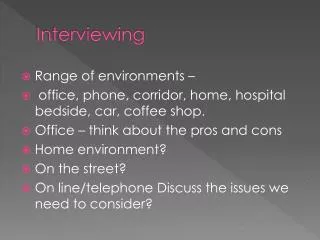
Interviewing • Range of environments – • office, phone, corridor, home, hospital bedside, car, coffee shop. • Office – think about the pros and cons • Home environment? • On the street? • On line/telephone Discuss the issues we need to consider?
Setting • For some the home may be appropriate • But can entail disruptions – TV, visitors, children • Agency worker may feel more at home in the office but does the client? • Think about the impact of the environment on the process of engagement.
Practice settings • Different practice settings will have different policies and procedures regarding what can be done by whom and to who. • The mandate of the agency provides the framework for the relationship of worker and client • Need to be clear about the role and purpose of the agency and worker.
How clients come into contact • Self referral –initiate own contact • Referral - Someone else refers the client - by phone or in writing • Mandated attendance – legal obligation
Beginning the process • Greetings and introductions • Discussing purpose • Confidentiality • Record keeping –the written documentation- notes of progress, assessments, letters • Privacy legislation • Explaining agency limits- confidentiality, note taking , eligibility.
Skills • Empathy • Verbal and non verbal communication skills • Questioning
Involuntary Clients • Formal court orders • Other forms of compulsion- e.g school insists on a young person seeing a counsellor • Worker is part of the sanction • Try to see the strengths - focus on what the person does well • Belief that everyone has strengths and resources
Solution focused • Focus is less on the problem more on the solutions to the problem • Search for exceptions to the problem • Encourage appropriate goals - how things will be different when the problem is no longer there • Encourage pro social actions and encourage and praise • Challenge anti social actions
Problem solving Model • Identify the issues of concern • Identify what to work on first -priority • Why is the client a client? EG a drug problem – then focus on this first • Goals are specified in relation to the problem i.e what specifically do they want to achieve? • Strategies are developed/contract is agreed • Review is ongoing • Use alongside a strengths focus.
Think about • Barriers -not easy to ask for and receive help • Fears and anxieties • Involuntary clients • Is the agency accessible? • Appearance and physical location • Friendliness of staff • Reception • Furniture/tea/coffee/play area
Common Anxieties of the worker • Not being able to help • Causing harm • Fear of hostility • Fear of loss of control of the interview • Fear of rejection and aggression • Fear of painful feeling brought up by the client’s situation • Other?
Activity • Exercise – short practice session • Partialising and sorting • Practice exercises - triads
Practice Interviews • Think of a real conflict or difficulty • Interview the person asking for a general outline about the situation and about the feelings attached • Search for facts- give me specific examples and information of what was said, what you did, what happened next etc, • Search for feelings How did you feel when this happened? Search for meaning - what does this all mean to you? Bring out facts feelings and meaning.
Interviews • Refer to interview structure hand out • Refer to interview checklist hand out. • Practice your skills!