Download
1 / 11
110 likes | 241 Views
The Czech Republic, the geographical heart of Europe, spans 78,866 km². Its highest point is Mt. Snezka at 1,602 m, while the lowest is near Hrensko at 117 m. The capital, Prague, has a population of 1.2 million. The Moravian-Silesian Region, located in the northeast, borders Poland and Slovakia, housing 1.3 million residents across six districts. It features rich cultural infrastructure, including universities and museums, and its economy is supported by coal mining and heavy engineering, though it has seen significant industry reduction since 1989.

E N D
Czech Republic Basic Information
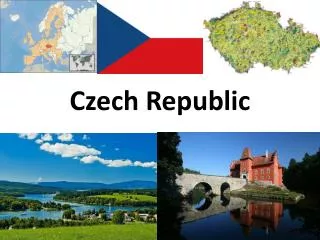
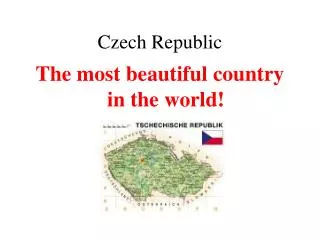
Location • geographical centre of Europe • area 78 866 sq. km • The highest point of elevation - Mt. Snezka (1 602 m above sea level) • The lowest point of elevation - near Hrensko where the River Labe leaves Czech territory (117 m above sea level) • Capital city – Prague (1,2 mil. citizens)
Economics • Currency – Czech Crown (1 crown – 100 hellers) • 1 EUR = 30 CZK • 1 USD = 24, 68 CZK • GDP
Moravian-Silesian Region Basic Information
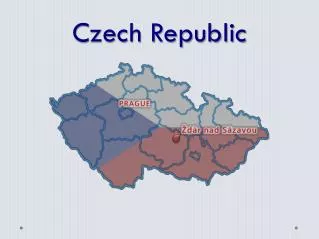
Geographic and demographic data • North-east part of Czech Republic • Borders with Poland (north, east) and Slovakia (east) • 6 districts (Bruntal, Frydek-Mistek, Karvina, Novy Jicin, Opava and Ostrava) • 5555 sq. km, 1,3 mil. inhabitants
The social infrastructure • 3 universities • VSB-TU Ostrava (technical and economic education; 6 faculties) • University of Ostrava (natural, human sciencies, health care; 4 faculties) • Silesian University (economic, natural, human sciencies; 2 faculties)
Regional centre of culture • 15 museums • 8 theatres • Hundreds of public libraries; State Science Library • Janacek Philharmonic Orchestra • National heritage city zones – Novy Jicin, Stramberk, Pribor
Industry • Main employer in the region • Coal mining, metallurgy, heavy engineering • Chemical, pharmaceutical, electrotechnical • Reducing industry • Coal mining (1989-2000 reduced by 50%) • Steel industry (1989-2000 reduced by 80%) • Privatisation process • 1990-1995 reduction of state-owned companies, quick rise of private companies
The transport infrastructure • Road communication system • E 75: Opava-Ostrava-Cesky Tesin-Mosty near Jablunkov (border with Slovakia) • E 462: Novy Jicin-Frydek-Mistek-Cesky Tesin • D 47: motorway; still under construction • Railway systém • Being modernized nowadays • European Transit Corridor VI in progress • Air transport • Ostrava-Mosnov international airport • Several small airports with grass runways
Partner Searches for FP6 • Bochemie s.r.o. • CDV • Janites s.r.o. • LinuxBox s.r.o. • OU-IC • OU-Servis • Vitkovice – R & D s.r.o.