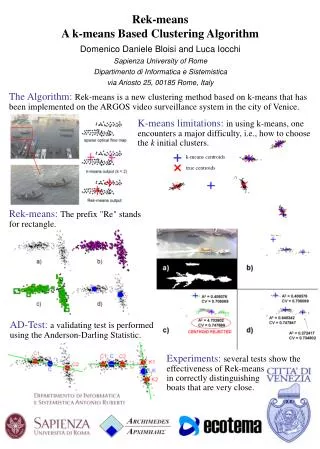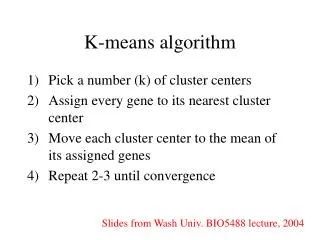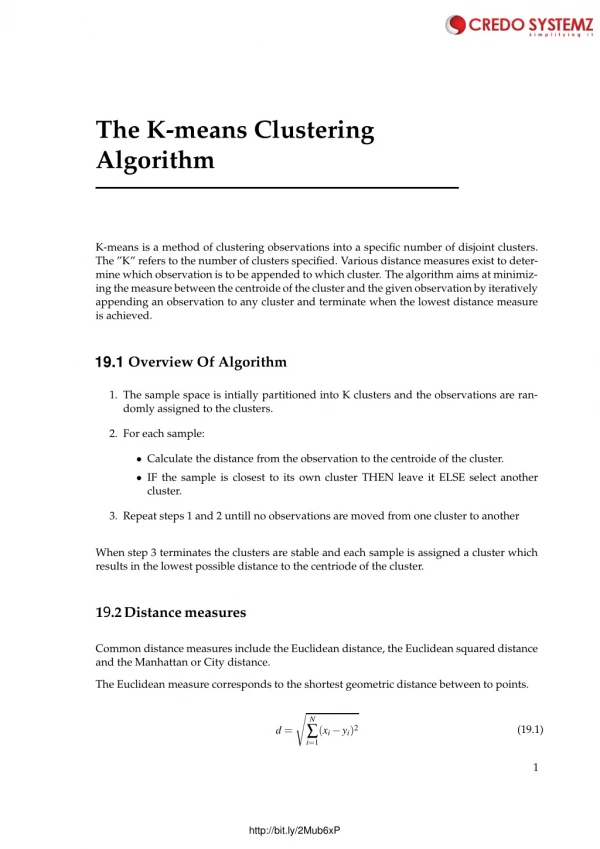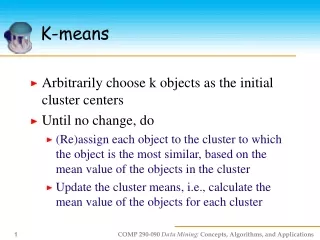
Steps of K-means algorithm
110 likes | 238 Views
This guide delves into the K-means clustering algorithm, outlining its essential steps, including random initialization of cluster centers, label reassignment based on proximity, and recomputation of centers based on new labels. Key processes ensure that centers are initialized at random sample locations, leading to efficient clustering. It also explores alternative initialization methods, such as starting centers at random locations within defined bounds or using evenly distributed points, enhancing the algorithm's effectiveness. Follow these steps to understand how K-means converges to optimal clusters.


Steps of K-means algorithm
E N D
Presentation Transcript
Initialize Centers at random sample locations Reassign labels to nearest centers
Initialize Centers at random sample locations Recompute Centers according to new labels NO CHANGE => FINISHED!
Initialize Centers at random locations within bounds bounds Randomly generated profiles
Initialize Centers at `evenly’ distributed points bounds `Evenly’ spaced profiles