Understanding Ocean Currents: Causes, Patterns, and Climate Interactions
Ocean currents are vital to Earth's climate and ecosystems, generated by various factors including surface winds, water density differences due to salinity and temperature, and evaporation-induced sea level gradients. This overview explores the mechanisms behind ocean currents, their major global patterns, and how they influence regional climates. Key currents such as the Gulf Stream, Humboldt, and Kuroshio are examined, along with phenomena like El Niño and La Niña, which significantly impact marine productivity and weather patterns.

Understanding Ocean Currents: Causes, Patterns, and Climate Interactions
E N D
Presentation Transcript
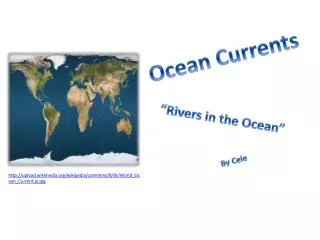
Ocean Currents • Some key questions: • What causes the ocean currents? • What are the global ocean current patterns? • How do ocean currents interact with climates? https://mediaplayer.pearsoncmg.com/assets/4ALEUTqaD5kmQVbrebIXu_pvWObSSpIz
Ocean Currents • Ocean currents are generated by • surface winds • differences in surface water density, due to salinity and temp. diff. (thermohaline circulations) • evaporation-induced sea level gradients • Surface Currents: • generally flow in sub-basin scale circulations known as gyres • deflected by Coriolis Force, so surface current differs up to 45° from overlying wind (apparent deflection to the _ in the N. Hem, to the _ in S. Hem. See next slide) • E. margins of oceans: are cool for their latitude (eg. Humbolt, California, Benguelan Currents). Flow equatorward. Coolness adjacent to continents is accentuated by coastal upwelling (explained later). • W. margins of ocean basins are warm for their latitude (eg. Gulf Stream, Kuroshio Currents), & flow poleward
Major Ocean Currents Figure 4.21
Pacific Ocean Currents Figure 1
Deep Thermohaline Currents Figure 4.22
Coastal Upwelling • driven by winds that induce near-surface water currents to have an offshore component (Coriolis Effect) • significant on west coasts, particularly high sun season • Oregon Coast example: upwelling causes cool surface temperatures, is often associated w/ fogs • also observed anywhere where wind has an offshore component (Central American example) Equatorial Upwelling Pacific Equatorial Region (Equatorial upwelling) http://oceanmotion.org/html/background/upwelling-and-downwelling.htm Sea floor topography-induced upwelling
Ocean Currents and Climate • El Niño/Southern Oscillation (ENSO): A weakening or reversal of the normal east-to-west flow of the trade winds and surface ocean currents in the tropical Pacific. Sea surface temps. rise in eastern Pacific, coastal upwelling and marine productivity diminished. • La Niña: An unusually strong east-to-west flow of the trade winds in surface ocean currents in the tropical Pacific, associated with cooler water temps. • Enormous amounts of heat are transferred between tropics and higher latitudes via the ocean currents, moderating climates in both regions. • The Gulf Stream and World History…