Understanding Optical Telescopes: Refractors vs. Reflectors
Explore the fundamentals of optical telescopes, including the two main types: refractors and reflectors. Refractors utilize lenses to focus light, offering steady images but facing issues like chromatic aberration and sagging lenses. In contrast, reflectors use curved mirrors to gather light, overcoming chromatic aberration, and are often lighter and more cost-effective, despite needing frequent alignment. This overview also delves into telescope magnification, brightness, historical advancements, and offers guidance on selecting the right telescope for your needs.

Understanding Optical Telescopes: Refractors vs. Reflectors
E N D
Presentation Transcript
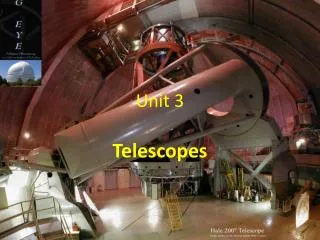
Unit 3 Telescopes
Optical Telescopes • Two basic types • Refractors • Reflectors
Refractors • Uses lenses to gather and concentrate light
Refractors • Advantages: • Refractor telescopes are rugged • Lenses inside the tube is sealed so it rarely needs cleaning • images are steadier and sharper • Disadvantages: • chromatic aberration • Lens supported only at the ends, lens will sag • Expensive, heavy
Reflectors • Uses a curved mirror to focus incoming light
Reflectors • Advantages: • Do not suffer from chromatic aberration • Can be made very BIG! • Less expensive, lighter • Disadvantages: • Optics need more frequent alignment • Open to the outside, need frequent cleaning • Secondary mirror can produce diffraction effects
Types of Reflectors • Gregorian • Newtonian • Cassegrain
Telescope magnification Magnification = focal length of telescope / focal length eyepiece e.g. focal length of telescope = 1000 mm focal length of eyepiece = 30 mm magnification = 1000 mm/ 30 mm = 33
Brightness • The observed brightness of an object is directly proportional to the area of the telescope mirror, e.g. a 5 meter telescope will have a light gathering capacity 25 times (52) greater than a 1 meter telescope
History of Large Telescopes • William Herschel (late 1700s)
Mt. Wilson (1917) • 100 inch
Hale (1948) • 200 inch
Space Telescopes • outside the distortion of Earth's atmosphere • extremely sharp images • almost no background light
Space Telescopes • Hubble • Spitzer • Chandra
Kepler Space Telescope • Designed to discover Earth-like planets
Herschel Space Observatory Launched in 2009 by the European Space Agency Sensitive to Infrared radiation
Image Acquisition & Processing • Charge-coupled devices (CCDs) computer (very efficient)
How to pick a telescope • Start by using your bare eyes • Next, move up to binoculars • When you’re ready for a telescope, read/ research
Choosing the right telescope • Performance • Purpose • Portability • Light Pollution • Price
All other things being equal, the greater the mirror/ lens diameter the greater the light gathering ability • Primary Mirror Size Square Inches of Aperture 4" 12 6 28 8 50 10 78 12 113 • http://www.astronomics.com/main/category.asp/catalog_name/Astronomics/category_name/How%20to%20pick%20a%20telescope/Page/1