Understanding Public Opinion: Values, Beliefs, and Attitudes in Society
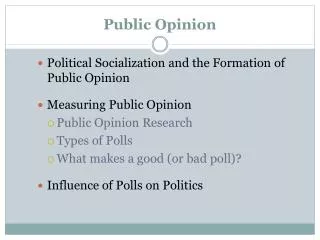
Public opinion represents the overt expression of values, beliefs, and attitudes by segments of society and extends beyond politics and government. We measure public opinion through polls and surveys, revealing insights into societal values and behaviors. Factors such as political socialization, media influence, and demographic variables shape opinions, highlighting their dynamic nature. Understanding public opinion is crucial for comprehending its impact on public policy and democracy itself. Explore the complexities and measurement techniques behind this vital aspect of society.

Understanding Public Opinion: Values, Beliefs, and Attitudes in Society
E N D
Presentation Transcript
What is Public Opinion? • Overt expression of values, beliefs, and attitudes by some segment of society. • Values: basic orientation to politics and life • Beliefs: perceptions of reality • Attitudes: positive or negative orientations toward an object • Not strictly limited to politics and government.
How Do We Measure Public Opinion? • Usually measured via public opinion polls (surveys). • Sometimes from focus groups • What do we learn from polls? • Values, attitudes, beliefs • Facts • Behavior • Sampling procedures. • Population vs. Sample • Random vs. non-random (biased) • Sample size
Problems with Survey Questions • Question wording is another potential source of error • Sensitive questions • Biased questions • Confusing questions • Non-attitudes
Where to Get Public Opinion Information • www.pollingreport.com • www.gallup.com
How Are Opinions Formed? • Political Socialization • Retrospective Modification
Political Socialization • Explicit or implicit • Agents of socialization • Family • Schools • Peers • Adult socialization
Retrospective Modification • Socialization AND political experiences • Looks something like this: Political Events SocializationOpinion Mass Media
The Role of the Media • Inform • Agenda setting • Framing • Persuasion
Attitudes, Beliefs, and Values • Short-term attitudes and beliefs • Candidate evaluations, issues, etc. • Long-term attitudes and beliefs • Party affiliation, efficacy, trust • Core values • Democratic principles, ideology • Political knowledge
Public opinion and public policy • Evidence of congruence • Evidence of incongruence • Explanations
Opinion gaps • Education • Sex • Race • Religion