Understanding Electron Dot Formulas: Bonding in Ionic and Covalent Compounds
130 likes | 246 Views
This lesson explores electron dot formulas for ionic and covalent compounds, focusing on the concepts of bonding and nonbonding electrons. Students will learn how to draw these formulas, identify bonding pairs and nonbonding pairs, and understand the octet rule and its exceptions. The course covers the formation of ions through electron transfer, as well as covalent bonds through electron sharing. Real-life examples include ion formation in sodium (Na) and fluorine (F), and the structure of water (H₂O). A solid understanding of these principles is essential for mastering chemical bonding.


Understanding Electron Dot Formulas: Bonding in Ionic and Covalent Compounds
E N D
Presentation Transcript
Lesson Objectives • Draw electron dot formulas • Ionic compounds • Covalent compounds • Electron Dot Formulas
Bonding electrons – electrons used for bonding • Single dots on a side of the symbol • Nonbonding pairs – electrons not used for bonding • Paired dots on a side of the symbol • Bonding vs. Nonbonding Electrons nonbonding pair P bonding e- bonding e- bonding e-
Noble gases have octets of electrons • Noble gases have the most stable electron configurations • Stable–electron arrangement that resists spontaneous change • Octet rule– atoms gain, lose, or share electrons to fill their valence shells with eight electrons and achieve stability • Hydrogen and helium are octet rule exceptions • Follow the duet rule • Highest energy shell only holds two electrons • The Octet Rule Ex)
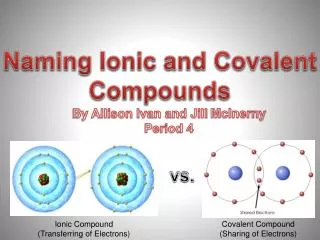
Valence Electrons and Bonding • Chemical bonds are created by the transfer or sharing of valence electrons • Covalent bonds are formed by electron sharing • Ionic bonds are formed by electron transfer
Ions form when electrons are lost or gained • Ionic charges are based on the number of electrons lost or gained • Losing or gaining electrons changes the ratio of positive particles (p+) to negative particles (e–) and causes an overall charge to form • Valence Electrons and Ion Formation Ex) Na lost 1 e– to become Na+ F gained 1 e– to become F- 10 e- 10 e- 11 p+ 9 p+ + + +1 charge -1 charge
Valence Electrons and Ion Formation • Generally, charge can be be determined by an ion’s group number • Metals lose valence electrons to form cations • Nonmetals gain valence electrons to form anions 1+ 3+ 2- 1- 3- 2+
Electron Dot Structures for Ions • Excess or deficit of electrons will be represented by • Number of electrons around the symbol • Charge outside the dot structure Ex) Neutral calcium becomes a calcium ion 2+ Ca Ex) Neutral sulfur becomes a sulfide ion 2- S
Ionic compounds are held together by the attraction between oppositely charged ions • Ionic Electron Dot Formulas Ex) Formation of KBr Br – Br K Transfer K+
Ionic Electron Dot Formulas Ex) Electron dot formula for Li2O 2- O O Li+ Li+ Li Li + +
Molecules and covalent compounds are held together by electron sharing • Covalent bonds are represented by lines drawn between atoms • Each line represents a pair of electrons that are shared between two atoms Covalent Electron Dot Formulas Ex) Br2 Br Br
Draw structure for central atom • Central atom is usually the least electronegative • Draw structures for surrounding atoms • Check for octets • Consider exceptions • Connect bonding electrons between atoms Covalent Electron Dot Formulas Ex) NH3 N H H H
Some compounds may require more than two electrons to be shared between two atoms to fill each atom’s octet • 4 shared electrons = double bond • 6 shared electrons = triple bond • Multiple Bonds • Ex) O2 O O • Ex) N2 N N
Covalent Electron Dot Formulas Ex) Electron dot formula for the synthesis of water 2H2(g) + O2(g) 2H2O(l ) O O + + + O O H H H H H H H H