Understanding Cell Transport Mechanisms: Diffusion, Osmosis, and Active Transport
This chapter explores essential processes of cell transport, focusing on diffusion and osmosis, and comparing passive and active transport. Key vocabulary includes osmosis, diffusion, passive transport, active transport, endocytosis, exocytosis, and semipermeable membranes. Learn how water diffuses through semipermeable membranes, how particles move across cell membranes with or without energy, and the mechanisms that allow cells to take in large particles or expel waste. This foundational knowledge is vital for understanding cellular functions and energy metabolism.

Understanding Cell Transport Mechanisms: Diffusion, Osmosis, and Active Transport
E N D
Presentation Transcript
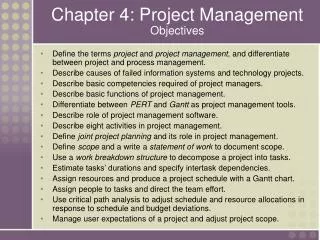
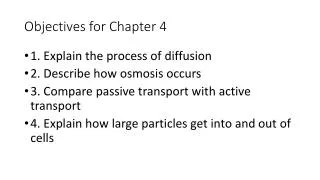
Objectives for Chapter 4 • 1. Explain the process of diffusion • 2. Describe how osmosis occurs • 3. Compare passive transport with active transport • 4. Explain how large particles get into and out of cells
Chapter 4:Vocabulary osmosis: diffusion: passive transport active transport endocytosis: exocytosis: semipermeable: Go to Chapter 4 in your online textbook and define these words
Vocabulary Defined • osmosis- the diffusion of water through a semipermeable membrane • diffusion- the movement of particles from regions of high concentration to low concentration (no energy required) • semipermeable- only certain substances can pass through
Examples of Osmosis • Red blood cells • Plant cells
Moving Small Particles • passive transport-movement of particles across a cell membrane without the use of energy (move from high concentration to low concentration) • active transport-movement of particles to requires energy from low concentration to high concentration • diffusion
Moving Large Particles • endocytosis-active transport process by which a cell surrounds a large particle such as a protein and encloses the particle in a vesicle to bring the particle “into” the cell • exocytosis- active transport process that the cell uses to enclose waste materials that are inside the cell to release them out of the cell
Worksheet • Fill in the worksheet
Homework Watch Brainpop for the following: (aacp; 123) • diffusion • passive and active transport I will quiz you on these tomorrow!
Objectives • Describe photosynthesis and cellular respiration • Compare cellular respiration with fermentation
Vocabulary • photosynthesis • cellular respiration • fermentation • pigments
Cellular respiration • Chemical process that takes place in cells • Takes place in the mitochondria • Most of the energy released is used to maintain body temperature C6H12O6 + 6O2 --> 6CO2 + 6H2O + energy
Fermentation • The breakdown of food to obtain energy without the use of oxygen • Examples: leg cramps (burning sensation) • One type: when muscles produce lactic acid when oxygen is unavailable • Bacteria, fungi, and yeast are other examples