Download

1 / 12
120 likes | 266 Views
This lesson equips you with the skills to effectively convert units between metric and customary systems. You'll learn to identify conversion factors and apply them correctly to ensure accurate calculations. Key steps include determining the appropriate conversion factor, choosing the correct conversion method, and executing the conversion process. Detailed examples illustrate converting fluid ounces to cups and pounds to kilograms. Be sure to save a copy of this guide for future reference, enabling you to navigate unit conversions with confidence.

E N D
Unit Conversions Lesson 2.07
After completing this lesson, you will be able to say: • I can determine the appropriate conversion factor when converting units. • I can convert units between metric and customary systems.
Conversion Factors Conversion factor: A factor used to multiply or divide a quantity when converting from one unit to another so that units can cancel, which has an overall value of 1.
Conversion Table It is recommended that you save a copy of this or print it so that you have this readily available for future use. You can print a copy on page 2 of your lesson.
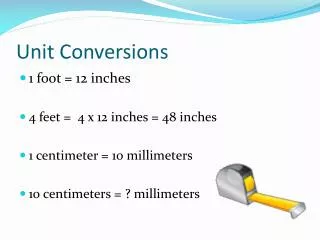
Converting Units of Measure Step 1: Determine the conversion factor Step 2: Choose the correct conversion Step 3: Perform the conversion
Converting units of measure 20 fluid ounces (floz) = ___ cups Step 1: Determine the conversion factor Step 2: Choose the correct conversion Reminder – you want to convert from ounces to cups, chose the conversion factor that will allow units to cancel when multiplied. Think of it as , which conversion factor will allow the units to cancel? x Step 3: Perform the conversion x= = = 2 cups
Multiple step conversions 85 inches = ___ yards Determine the first conversion factor Remember, you want to convert from inches to feet. You want the inches to cancel so they should be in the denominator or Frist conversion Determine the second conversion factor or Remember, you want to convert from feet to yards. You want the feet to cancel so they should be in the denominator
Metric Conversions It is recommended that you save a copy of this or print it so that you have this readily available for future use. You can print a copy on page 3 of your lesson.
Converting Units of Measure Step 1: Determine the conversion factor Step 2: Choose the correct conversion Step 3: Perform the conversion
Converting Units of Measure Max has a piece of luggage that weighs 23.4 pounds. Convert this weight into kilograms. Step 1: Determine the conversion factor 1 pound = 0.454 kilogram Step 2: Choose the correct conversion Remember, you want to convert from pounds to kilograms. You want the pounds to cancel so they should be in the denominator Step 3: Perform the conversion = 23.4 x 0.454 kilograms = 10.6236 kilograms Max's luggage can be rounded to 10.62 kilograms
Now that you completed this lesson, you should be able to say: • I can determine the appropriate conversion factor when converting units. • I can convert units between metric and customary systems.