Download

1 / 11
110 likes | 233 Views
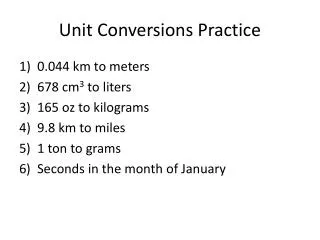
This guide explores the principles of dimensional analysis, emphasizing the importance of unit conversions in various contexts. It clarifies the concept of “in ones” conversions, highlighting common pitfalls where the numerator and denominator differ, resulting in erroneous conclusions. Key examples include converting seconds to hours, days to seconds, and meters to nanometers. Engage with your peers by reviewing your Basic Math concepts related to these conversions before taking the quiz. Ensure your group is prepared to complete the quiz by Friday!

E N D
Definition of Dimensional Analysis: • Problem-solving method that uses the fact that any number or expression can be multiplied by one without changing its value
True “in ones” [unit conversions]:these examples have a value of 1 (the numerator and denominator are the same value!)
False “in ones” [unit conversions]: these are common errors! They DON’T have a value of 1 because the numerator and denominator are difference values!
Your Task • Take out your Basic Math Review Packet • Turn to the section on Dimensional Analysis and begin correcting and reviewing your answers in your Study Groups • When you feel your group is ready, ask for the quiz! • All quizzes must be completed by this Friday.