Comprehensive Guide to Connective Tissue Types and Functions
Connective tissue is the most abundant and widely distributed tissue type in the body, serving functions such as binding, support, protection, and storage. This guide covers the characteristics, functions, and locations of various connective tissue types, including loose connective tissue (areolar, reticular, adipose), dense connective tissue (regular, irregular), cartilage (hyaline, elastic, fibrocartilage), bone, and blood. Learn about the structure of connective tissue fibers and their role in maintaining tissue integrity.

Comprehensive Guide to Connective Tissue Types and Functions
E N D
Presentation Transcript
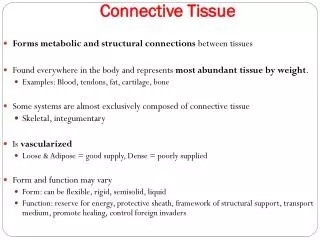
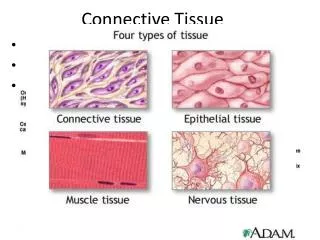
Most abundant, variable, and widely distributed of all tissue types.
Functions • Binding • Support • Protection • Storage • Transport
Characteristics • Most are well-vascularized • All are made up of: • Cells • Extra-cellular matrix – nonliving, 2 components: • Ground Substance – glue-like material between cells • Fibers – vary depending on tissue types
3 Types of Fibers • Collagenous – woven strands of the protein collagen, the most abundant protein in the human body • Thick fibers • Great tensile strength (hard to pull apart) Collagen Fibers as seen with a scanning electron microscope Close-up of a single fiber
Reticular – thin collagen fiber coated with glycoproteins • Branch extensively • Form frameworks for organs Fibers are stained black in this pic of the liver
Elastic– made of the protein elastin • Can stretch and recoil • Found in lungs, arteries, and skin In this slide, “A” is an elastic fiber – what do you suppose “B” is?
Loose Connective Tissue – 3 Types • Lots of cells • Lots of ground substance • Lots of empty space • Few Fibers • Vascular
1. Areolar Functions • Cushions & protects • Packages & binds • Immune defense • Water & salt reservoir Locations • Surrounds organs • Underlies most epithelia
2. Reticular Functions • Forms the stroma, or framework, inside lymphatic organs Locations • Lymph nodes • Spleen • Thymus • Bone marrow
3. Adipose Functions • Energy storage • Thermal insulation • Shock absorption • Protective cushioning for some organs Locations • Fat beneath skin • Breast • Heart surface • Kidneys, eyes
Dense Connective Tissue – 2 Types • Lots of fibers • Few cells • Little ground substance • Very few blood vessels
1. Dense Regular Functions • Bind muscle to bone and transfer tension • Bind bone to bone and resist stress Locations • Tendons • Ligaments
2. Dense Irregular Functions • Provides durable, hard to tear structure, that can withstand a variety of stresses Locations • Deep portion of skin • Capsules around visceral organs e.g. spleen, liver, kidney • Fibrous sheaths around cartilage and bone
Cartilage – 3 types • Avascular • Metabolism and rate of mitosis is slow, so healing is a long process Based on this, why do you suppose shark cartilage has been touted as a possible aid in the fight against cancer?
1. Hyaline Functions • Precursor to bone skeleton • Attachment • Eases joint movements Locations • Fetal skeleton • Ribs-sternum • Ends of bones
2. Elastic Functions • Flexible, elastic support Locations • External ear • epiglottis
3. Fibrocartilage Functions • Resists compression • Absorbs shock Locations • Pubic symphysis • Intervertebral discs • Menisci (shock-absorbing pads of knee)
Bone Functions • Support, protection • Calcified matrix • Collagen fibers Locations • You know where…
Blood Functions • Transports nutrients, wastes, gases • Fluid matrix • Fibers visible during clotting Locations • Hmmm??