Download
1 / 6
60 likes | 175 Views
This discussion addresses the critical scientific requirements for measuring the Warm-Hot Intergalactic Medium (WHIM) emission. Key aspects include achieving a resolution better than 2 eV to distinguish WHIM from foreground emissions, the need for a large field of view (20’) with effective area >1000 cm², and collaboration with new simulations to enhance data accuracy. The work emphasizes the use of gamma-ray bursts (GRBs) to study filaments and emphasizes the importance of low instrumental background and spatial resolution for reliable measurements. Such advancements are vital for constraining the matter density parameters.

E N D
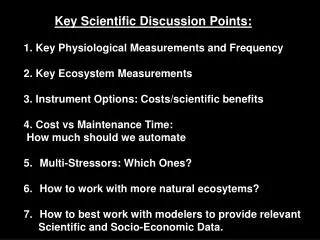
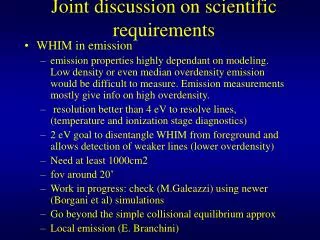
Joint discussion on scientific requirements • WHIM in emission • emission properties highly dependant on modeling. Low density or even median overdensity emission would be difficult to measure. Emission measurements mostly give info on high overdensity. • resolution better than 4 eV to resolve lines, (temperature and ionization stage diagnostics) • 2 eV goal to disentangle WHIM from foreground and allows detection of weaker lines (lower overdensity) • Need at least 1000cm2 • fov around 20’ • Work in progress: check (M.Galeazzi) using newer (Borgani et al) simulations • Go beyond the simple collisional equilibrium approx • Local emission (E. Branchini)
WHIM in absorption • low density sampled with absorption lines. Going to higher z (vs the bright agn sample) with GRB increases the chances to have more filaments, and allow complementary measurements of the same filament in absorption and emission when the afterglow dies away. • Need resolution better than 2 eV: combined with area (1000 cm2), wide field GRB monitor and fast response build up a sample of about 100 los in 3 years. This is important to put a constraint on Omega B at the level of few percent (Fiore). • Energy resolution: Goal <1eV to allow kinematics test (comparison with temperature braodening: test models)
Cluster cores and soft excess • Requirements as for WHIM in emission • Cluster outer regions • Large FOV 1 degree goal, requirement 30-40’ • Large Eff. Areas >1000 cm2 • Low Instrumental bkg and Low CXB : Spatial resolution around 5-10” needed to subtract from the bgk discrete sources. Can we achieve a comparable result selecting narrow line emission ? Is it possible to use triplets to get density estimation? : Fiore, Molendi) • High. Res. Spectroscopy: metal abundances in the outer part: Iron complex at low energy, Si, Mg, kinematics
Cluster (continued): • For the continuum temperature need to go up to at least 3-4 keV. Spectroscopy of Fe complex @ 6-7 kev mostly useful for kinematics • - Absorption studies using GRB through cluster/supercluster medium. What is the probability ? What is the EW through a cluster, (S. Molendi)
Can we constrain dark matter origin ? • From WHIM: Through distribution of filaments ? Need too many • Through cluster survey (but uncertainties in the mass estimate of the cluster. Need high spatial resolution for faint distant clusters). C.f.r. Rosita performances (Molendi) • Direct X-ray signatures (Colafrancesco) • Dark energy • GRB Hubble diagram ? (need spectrum up to 500 keV- 1MeV: Amati)
Converging towards a joint mission concept • Core mission (WHIM driven): • Telescope with A>1000cm2 with fov 30-60’ • Microcalorimeter TES as focal plane to cover the FOV (possibility of smaller pixels in the central part to increase the spatial resolution) • Energy extension from 0.1 to 2 keV • Fast slewing and WFM for transient localization • Additional benefit: science on clusters + GRB & transients, brings in a very wide community • Options to be studied : TES in the central part, ccd in the outer part (or two telescopes) • Trade off on focal lenght and/or multilayer coating for higher energies(cluster continuum temperature, Iron line, polarimeter)