Download
1 / 1
10 likes | 185 Views
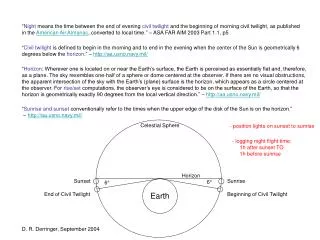
This document outlines key definitions related to civil twilight and the concept of night as it pertains to flight operations. Civil twilight occurs when the sun is geometrically 6 degrees below the horizon, defining both morning and evening twilight times. In practical terms, night is the period between evening civil twilight and morning civil twilight, which are crucial for pilots logging flight times. Additionally, the document describes the horizon's geometric properties and how they are relevant to sunrise and sunset calculations, enhancing operational planning for night flying.

E N D
“Night means the time between the end of evening civil twilight and the beginning of morning civil twilight, as publishedin the American Air Almanac, converted to local time.” – ASA FAR AIM 2003 Part 1.1, p5 “Civil twilight is defined to begin in the morning and to end in the evening when the center of the Sun is geometrically 6degrees below the horizon.” – http://aa.usno.navy.mil/ “Horizon: Wherever one is located on or near the Earth’s surface, the Earth is perceived as essentially flat and, therefore,as a plane. The sky resembles one-half of a sphere or dome centered at the observer. If there are no visual obstructions,the apparent intersection of the sky with the Earth’s (plane) surface is the horizon, which appears as a circle centered atthe observer. For rise/set computations, the observer’s eye is considered to be on the surface of the Earth, so that thehorizon is geometrically exactly 90 degrees from the local vertical direction.” – http://aa.usno.navy.mil/ “Sunrise and sunset conventionally refer to the times when the upper edge of the disk of the Sun is on the horizon.” – http://aa.usno.navy.mil/ Celestial Sphere - position lights on sunset to sunrise - logging night flight time: 1h after sunset TO 1h before sunrise Horizon Sunset Sunrise 6° 6° End of Civil Twilight Earth Beginning of Civil Twilight D. R. Derringer, September 2004