Maximizing Housing Performance Through MIM: A Case Study
50 likes | 66 Views
Explore how Metal Injection Molding (MIM) enhanced housing application in telecommunications electronics. Discover the functional requirements met, competing technologies, and the economic advantages of MIM.


Maximizing Housing Performance Through MIM: A Case Study
E N D
Presentation Transcript
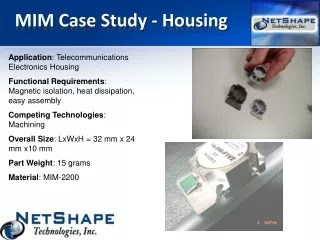
MIM Case Study - Housing Application: Telecommunications Electronics Housing Functional Requirements: Magnetic isolation, heat dissipation, easy assembly Competing Technologies: Machining Overall Size: LxWxH = 32 mm x 24 mm x10 mm Part Weight: 15 grams Material: MIM-2200
Key Characteristics- Housing Threads added as a secondary operation to accommodate protective lid Side holes for assembly and logo created through slides Thin sections < 1 mm Flatness for heat dissipation, proper assembly - < 0.1 mm
MIM Case Study - Housing • Why MIM? • Production rates > 50,000 per month at peak easily handled by a 4-cavity tool • Replication of details (radii, logo, hole locations, etc.) in MIM was excellent with little variation • Good magnetic properties for shielding • No problem with plating (Ag over Ni) • Little material waste • Fewer burr removal problems • Side slots for assembly handled in tooling
MIM Case Study - Housing • MIM Issues • Flatness < 0.1 mm required for heat dissipation and assembly of fragile components • Coining on low-tonnage press helped with delivering assured flatness for 32 mm x 24 mm area • Processing conditions played a key role in getting the best flatness out of the furnace • Finally needed a grinding operation to assure compliance • Quality of thread (40UNS) on 21 mm ID • Geometry and quality would not allow molded-in threads • Machined in-house on CNC
MIM Case Study - Housing • Economics • Needed a 4 Cavity tool for production rates and cost • The key to success was efficiency in secondary operations • Conclusion • Good application for MIM!