Understanding Glycolysis and the Link Reaction in Cellular Respiration
This resource delves into the vital processes of glycolysis and the link reaction in cellular respiration. It outlines the key steps and locations of these processes, highlighting their significance in energy production. Glycolysis occurs in the cytoplasm, where glucose is metabolized to release energy, while the link reaction prepares pyruvate for entry into the Krebs cycle. The discussion includes redox reactions, illustrating the interdependence of oxidation and reduction during these metabolic pathways. Suitable for students studying cellular biology.

Understanding Glycolysis and the Link Reaction in Cellular Respiration
E N D
Presentation Transcript
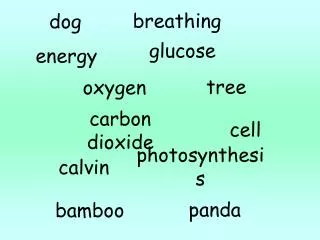
breathing dog glucose energy tree photosynthesis oxygen calvin cell panda carbon dioxide bamboo
Respiration Like photosynthesis, respiration can be broken down into separate reactions: • Glycolysis • Link reaction • Krebs cycle • Electron transfer chain
Objectives • Describe where glycolysis occurs and recall the steps • Describe where the link reaction occurs and recall the steps • Explain why glycolysis and the link reaction can be referred to as redox reactions.
Glycolysis and the Link Reaction Pages 163-166 of the Heinemann text book. Page 56 of Bill Indge -Steps -What is oxidised -What is reduced -Where it happens
Redox reactions OILRIG. Oxidation is loss (of electrons) Reduction is gain (of electrons). Oxidation and reduction reactions tend to happen in unison. If one molecule is oxidised, another is reduced.
Glycolysis • Occurs in both aerobic and anaerobic respiration. • Reaction happens in the cytoplasm of the cell. • Glucose contains a lot of chemical potential energy. Glycolysis aims to release some of this energy. • However ATP needs to be used in order to generate more • Net gain of 2 x ATP NAD =coenzyme It will accept electrons and hydrogen ions.
Glycolysis Redox • What are the products of glycolysis? • Write a redox equation for glycolysis. Pyruvate ATP Reduced NAD Triose phosphate = oxidised NAD = reduced Triose phosphate + NAD pyruvate + reduced NAD
Link Reaction • Aerobic respiration only. • Pyruvate (from glycolysis) still contains a lot of chemical potential energy. • When oxygen is available, this energy can be harvested in the Krebs cycle. • Link reaction converts pyruvate into a 2C compound that can enter the Krebs cycle.
Link Reaction Redox • What are the products of the link reaction? • Write a redox equation for glycolysis. CO2 Reduced NAD Acetyl Coenzyme A Pyruvate = oxidised NAD = reduced Pyruvate + NAD acetylcoenzyme A + reduced NAD