RTK family classification & structure/function
Receptor Tyrosine Kinases (RTKs) play crucial roles in regulating diverse cellular responses, including cell division, differentiation (e.g., eye development in flies), and motility (such as in wound healing). With over 50 identified RTKs, they are categorized into 10 subclasses based on their extracellular ligand-binding domains, which include various types of domains. Oncogenic mutations, like the erbB gene truncation leading to a constitutively active EGF receptor, further illustrate their importance. RTK signaling involves ligand binding, receptor dimerization, autophosphorylation, and recruitment of SH2 domain proteins like Grb2 and PI-3-kinase.

RTK family classification & structure/function
E N D
Presentation Transcript
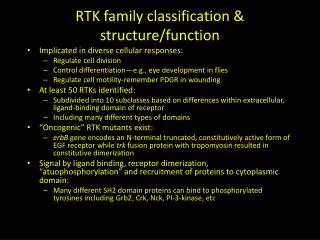
RTK family classification & structure/function • Implicated in diverse cellular responses: • Regulate cell division • Control differentiation—e.g., eye development in flies • Regulate cell motility-remember PDGR in wounding • At least 50 RTKs identified: • Subdivided into 10 subclasses based on differences within extracellular, ligand-binding domain of receptor • Including many different types of domains • “Oncogenic” RTK mutants exist: • erbB gene encodes an N-terminal truncated, constitutively active form of EGF receptor while trk fusion protein with tropomyosin resulted in constitutive dimerization • Signal by ligand binding, receptor dimerization, “atuophosphorylation” and recruitment of proteins to cytoplasmic domain: • Many different SH2 domain proteins can bind to phosphorylated tyrosines including Grb2, Crk, Nck, PI-3-kinase, etc