Download
1 / 15
150 likes | 253 Views
Explore UGA undergraduates' attitudes towards weight gain from alcohol consumption through surveys, observational research, and focus groups. Results reveal negative attitudes with significant correlations between alcohol intake and caloric adjustments. Discussions highlight the impact on health and suggest promoting new social norms. Limitations include time constraints and potential biases in sampling methods.

E N D
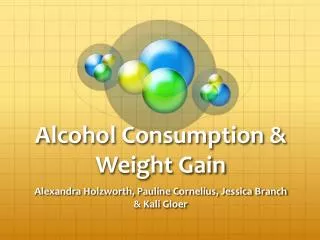
Alcohol Consumption & Weight Gain Alexandra Holzworth, Pauline Cornelius, Jessica Branch & Kali Gloer
Introduction • Background Scientific Research • Data from Relevant Studies • A quarter of participants gained at least five pounds (Drew) • Alcohol causes an imbalance of energy chemicals in the body (Suter)
Research Question • What attitudes do UGA undergraduates have towards weight gain as a result of alcohol consumption?
Research Based Hypothesis • As UGA undergraduates’ weight gain as a result of alcohol consumption increases, UGA undergraduates’ attitude towards alcohol consumption with decrease. • Negatively related
Method • Survey • 45 questions • Weight Gain as a Result of Alcohol Consumption (IV) • Weight Gain • Alcohol Consumption • Attitude (DV) • Influence/Reasons for Dinking • Perceptions of Alcohol
Method • Observational Research • Observer as Participant • Variables of interest • Demographics • Price/Amount/Type of Alcohol Consumed • Food Consumption
Method • Focus Groups • Two groups • 60 minute sessions • 4+ Participants per Group • 1+ Male (s), 1+ (s) Female
Method • Hypothetical Experimental Design • Stratified Random Sampling • 100 UGA Undergraduate Students • 50 Male, 50 Female • Study Duration • 3 Months • Studied Factors • Weight Gain • Academic Performance • Money Spent
Results-Quantitative • Survey • 74 Responses • College students 18-24 • 11 Male, 63 Female • Chi-Square Findings • Gender (IV) and Weight Gain (DV) • Asymptote Sig. = .000 • Gender (IV) and Willingness to Consume (DV) • Asymptote Sig. = .001 • Meaningful Difference between Expected and Observed
Results-Quantitative • Survey • Correlation Tests • Continuous Variables • Willingness to Modify Frequency Alcohol Consumption vs. Willingness to Modify Caloric Intake • (r = .664 and p<.001) • Consuming Alcohol Because of Social Accepting vs. Consuming Alcohol To Boost Self Esteem • (r= .835 and p<.001)
Results- Qualitative • Observational Research • 60 people Observed • 28 Male • 32 Female • Money>Taste>Calories • Eating Habits • Surroundings • Focus Group • Similar Settings • Varied Alcohol Preferences • Varied Consumption Frequencies • Weight Gain • Peer Pressure
Discussion • Interpretation • UGA undergraduates have a negative toward weight gain as a result of alcohol consumption • Hypothesis supported • Contextual Importance • Many UGA undergraduates consume alcohol • Many UGA undergraduates gain weight • Spread Awareness of Adverse Health Effects • Inspire New Social Norms
Limitations & Future Research • Limitations • Time Constraint • One-way ANOVA • Snowball Sampling
Limitations & Future Research • Future Research • Compare alcohol consumption in various college campuses in Georgia/US • In depth questions about what college students would/would not be willing to change • Undergraduate behavior changes when given nutritional facts • Age/Gender/Socio-economic comparisons