Download
1 / 18
180 likes | 324 Views
Dive into the world of angular mechanics with this comprehensive overview of rolling dynamics. Explore key concepts such as angular and linear quantities, tangential relationships, and useful substitutions. Learn how forces cause angular acceleration and see real-world applications through examples involving strings and pulleys. This guide provides essential formulas and problem-solving techniques necessary for tackling rolling objects and their motion on inclined planes. Master the principles of torque, moment of inertia, and more to enhance your grasp of dynamics.

E N D
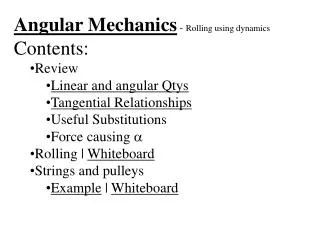
Angular Mechanics - Rolling using dynamics • Contents: • Review • Linear and angular Qtys • Tangential Relationships • Useful Substitutions • Force causing • Rolling | Whiteboard • Strings and pulleys • Example | Whiteboard
Angular Mechanics - Angular Quantities Linear: (m) s (m/s) u (m/s) v (m/s/s) a (s) t (N) F (kg) m Angular: - Angle (Radians) o - Initial angular velocity (Rad/s) - Final angular velocity (Rad/s) - Angular acceleration (Rad/s/s) t - Uh, time (s) - Torque I - Moment of inertia TOC
Angular Mechanics - Tangential Relationships Linear: (m) s (m/s) v (m/s/s) a Tangential: (at the edge of the wheel) = r - Displacement = r - Velocity = r - Acceleration* *Not in data packet TOC
Angular Mechanics - Useful Substitutions = I = rF so F = /r = I/r s = r, so = s/r v = r, so = v/r a = r, so = a/r TOC
Angular Mechanics - Force causing F r = I = rF so F = /r = I/r TOC
Angular Mechanics - Rolling mgsin I = 1/2mr2 m r - cylinder F = ma + /r mgsin = ma + I/r ( = I) mgsin = ma + (1/2mr2)(a/r)/r ( =a/r) mgsin = ma + 1/2ma = 3/2ma gsin = 3/2a a = 2/3gsin TOC
Whiteboards: Rolling 1 | 2 | 3 TOC
A marble (a solid sphere) has a mass of 23.5 g, a radius of 1.2 cm, and rolls 2.75 m down a 21o incline. Solve for a in terms of g and mgsin = ma + I/r, I = 2/5mr2, = a/r mgsin = ma + (2/5mr2)(a/r)/r mgsin = ma + 2/5ma = 7/5ma gsin = 7/5a a = 5/7gsin W 5/7gsin
A marble (a solid sphere) has a mass of 23.5 g, a radius of 1.2 cm, and rolls 2.75 m down a 21o incline. Plug in and get the actual acceleration. (a = 5/7gsin) a = 5/7gsin = 5/7(9.8m/s2)sin(21o) a = 2.5086 m/s2 = 2.5 m/s2 W 2.5 m/s/s
A marble (a solid sphere) has a mass of 23.5 g, a radius of 1.2 cm, and rolls 2.75 m down a 21o incline. What is its velocity at the bottom of the plane if it started at rest? (a = 2.5086 m/s2) v2 = u2 + 2as v2 = 02 + 2(2.5086 m/s2)(2.75 m) v = 3.714 m/s = 3.7 m/s W 3.7 m/s
Angular Mechanics – Pulleys and such r m1 m2 • For the cylinder: • = I • rT = (1/2m1r2)(a/r) • (Where T is the tension in the string) • For the mass: • F = ma • m2g - T = m2a TOC
Angular Mechanics – Pulleys and such r m1 m2 • So now we have two equations: • rT = (1/2m1r2)(a/r) or • T = 1/2m1a • and • m2g - T = m2a TOC
Angular Mechanics – Pulleys and such r m1 m2 • T = 1/2m1a • m2g - T = m2a • Substituting: • m2g - 1/2m1a = m2a • Solving for a: • m2g = 1/2m1a + m2a • m2g = (1/2m1 + m2)a • m2g/(1/2m1 + m2) = a TOC
Whiteboards: Pulleys 1 | 2 | 3 | 4 TOC
r m1 m2 A string is wrapped around a 12 cm radius 4.52 kg cylinder. A mass of .162 kg is hanging from the end of the string. Set up the dynamics equation for the hanging mass. (m2) m2g - T = m2a W figure it out for yourself
r m1 m2 A string is wrapped around a 12 cm radius 4.52 kg thin ring. A mass of .162 kg is hanging from the end of the string. Set up the dynamics equation for the thin ring (m1) = I, I = m1r2, = a/r, = rT rT = (m1r2)(a/r) T = m1a W figure it out for yourself
r m1 m2 A string is wrapped around a 12 cm radius 4.52 kg thin ring. A mass of .162 kg is hanging from the end of the string. Solve these equations for a: m2g - T = m2a T = m1a m2g - m1a = m2a m2g = m1a + m2a m2g = a(m1 + m2) a = m2g/(m1 + m2) W figure it out for yourself
r m1 m2 A string is wrapped around a 12 cm radius 4.52 kg thin ring. A mass of .162 kg is hanging from the end of the string. Plug the values in to get the acceleration: a = m2g/(m1 + m2) a = m2g/(m1 + m2) a = (.162 kg)(9.80 N/kg)/(4.52 kg + .162 kg) a = .339 m/s/s W .339 m/s/s