Maxwell's Equations in Material Mediums
160 likes | 323 Views
Explore Maxwell's equations in metals and dielectrics, including constitutive relations, wave propagation, and material properties. Learn about skin depth, plasma frequency, and dielectric relaxation time.


Maxwell's Equations in Material Mediums
E N D
Presentation Transcript
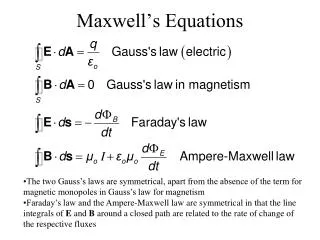
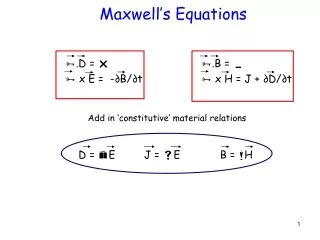
.D = r x E = -∂B/∂t .B = 0 x H = J + ∂D/∂t J = sE D = eE B = mH Maxwell’s Equations Add in ‘constitutive’ material relations
.B = 0 x H = J + ∂D/∂t .E = r/e x E = -∂B/∂t Free space, r =J =0
.E = r/e x E = -∂B/∂t Do x ( x E) .B = 0 x H = J + ∂D/∂t 2E = me∂2E/∂t2 Solution: Plane waves Wave equation One set of Solutions: Plane waves E(r,t) = E0ejwt-jbr b = mew = w/v
Maxwell in a metal: finite conductivity (r=0,J=sE) .B = 0 x H = s E + ∂D/∂t .E = r/e x E = -∂B/∂t • Dielectric relaxation time t (Time for charges to adjust in DC field) • Skin Depth d (Penetration for low frequency) • Plasma frequency wp (Time for charges to rearrange in AC field)
Maxwell in a metal: finite conductivity (r=0,J=sE) .B = 0 x H = s E + ∂D/∂t .E = r/e x E = -∂B/∂t • Dielectric relaxation time t (DC conductivity) • Skin Depth d (Distance over which AC fields decay) • Plasma frequency wp (Response time in alternating fields)
Maxwell in metal (r=0,J=sE) .D = 0 x E = - ∂B/∂t .B = 0 x H = J + ∂D/∂t ∂/∂t jw -jb • x ( x E) = -∂( x B)/∂t 2E = m∂J/∂t + me∂2E/∂t2 Use plane waves and phasors b2 = -jwsm + mew2 = meeffw2 whereeeff = e –js/w Complex b gives decaying wave
Loss: finite conductivity(r=0,J=sE) .D = 0 x E = - ∂B/∂t .B = 0 x H = J + ∂D/∂t eeff = e(1 –js/ew) (Note dimensions between s and e ! What “time” is this?)
Dielectric Relaxation Time EOC: ∂r/∂t = -. J = -s . E = -s . D/e • = -(s/e)r • = -r/t r = r0e-t/t • = e/s Higher conductivity, better metal smaller t Cu: 1/s = 1.7mW-cm, er = 6 , t = 5 x 10-19s After time t, charges/fields escape towards surface How close to surface ???
Skin Depth in Metals 2E = jwsmE - mew2E b2 = -jwsm + mew2 meeffw2 d Note that b is complex! • = bR + jbI E = E0ej(br-wt) = E0ej(bRr-wt)e-bIr Decays! P ~ |E|2 = |E0|2e-2bIr = P0e-r/d where • = 1/2bI is the skin depth (distance over which power decays)
Skin Depth in Metals 2E = jwsmE - mew2E b2 = -jwsm + mew2 Low frequency, drop second term • = bR - jbI ≈ (-jwsm)1/2 =(wsm)1/2 [1-j]/√2 • I ≈ (wsm/2)1/2 From previous slide, d = 1/2bI = (2/wsm)1/2
Skin Depth in Metals d = 2/(wsm) = 1/pfsm Skin Depth Cu: 1/s = 1.7mW-cm, f = 409 GHz, d = 0.1033 mm d High conductivity, high frequency signals eliminated from conductor Dimensions: d = c (t/pf) Length
Skin depth for various frequencies and materials Courtesy: Wikipedia
Why don’t fields penetrate? EM fields oscillate and create eddy currents Inside bulk, eddy currents oppose conduction current On surface over depth d, eddy currents helpconduction current (Courtesy: Wikipedia)
Is this true for fast signals? • If AC field varies too fast, eddy currents cannot keep up, neither can charges move fast enough to screen it in the bulk. • This means fast frequencies should have different screening properties than slow frequencies • Meaning even the bare e is frequency dependent !! For a conductor, eeff(w) = e(w) - js/w
The freq-dependent e -Im(e) Re(e) w e = e1(w) + je2(w) w0 wp Plasma frequency Resonant frequency
Plasmonics: A Field unto itself! Changing wp dynamics with size Nanogold: red in color!