Download
1 / 8
90 likes | 365 Views
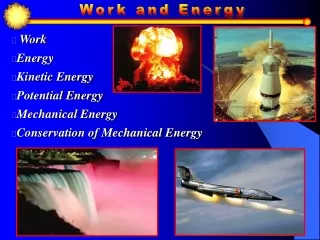
Energy. Units: Joules (J). Potential Energy (PE). An object can store energy as the result of its position. Potential Energy ( PE grav ). PE grav = mass * gravity * height. PE grav = mgh m = mass of object (kg) g = gravity = 9.8 m/s 2 h = height (m). m = PE grav /gh

E N D
Energy Units: Joules (J)
Potential Energy (PE) An object can store energy as the result of its position.
Potential Energy (PEgrav) PEgrav = mass * gravity * height PEgrav = mgh m = mass of object (kg) g = gravity = 9.8 m/s2 h = height (m) m = PEgrav/gh h = PEgrav/mg
Kinetic Energy Kinetic energy is the energy of motion. KE = ½mv2 m = mass of object (kg) v = speed of object
The Joule is the unit of work and energy. 1 Joule = 1 Newton * 1 meter 1J = 1 N * m =(Nm) Hoping to replace steam engines by electric motors, his first research sought to improve electric motor efficiency. His investigations concerned themselves with the production of heat. James Prescott Joule Great Britain (1818-1889)
Mechanical Energy ME = PE + KE The total amount of mechanical energy is the sum of the potential energy and the kinetic energy.