Using Bayesian Belief Networks in Assessing Software Architectures
160 likes | 331 Views
Using Bayesian Belief Networks in Assessing Software Architectures. Jilles van Gurp & Jan Bosch. Contents. Qualitative Knowledge in SD SAABNet Validation results. no quantitative information early in the design process. requirements spec. design. greater role of metrics in assessment.


Using Bayesian Belief Networks in Assessing Software Architectures
E N D
Presentation Transcript
Using Bayesian Belief Networks in Assessing Software Architectures Jilles van Gurp & Jan Bosch
Contents • Qualitative Knowledge in SD • SAABNet • Validation results SAABNet
no quantitative information early in the design process requirements spec. design greater role of metrics in assessment implementation test deployment Software Development SAABNet
But • Defect fixing becomes more expensive later in the development process • So there is a need to do assessments early on • There is not enough quantitative information available to use existing techniques SAABNet
Qualitative Knowledge • Examples • expert knowledge • general statistical knowledge • design/architecture patterns • Informal • Badly documented SAABNet
How to use Qualitative Knowledge • Assign expert designers to team • Do peer reviews of requirement specs. and designs • Try to document the knowledge • Use AI SAABNet
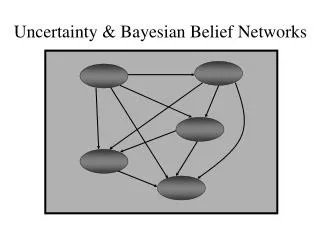
Bayesian Belief Networks • Model probabilistic distributions using information about dependencies between the variables • Are an excellent way to model uncertain causal relations between variables • SAABNet (Software Architecture Assessment Belief Network) SAABNet
More abstract Three types of variables • Architecture Attributes • programming language, inheritance • Quality Criteria • complexity, coupling • Quality Factors • maintenance, performance SAABNet
Usage • Insert what you know • Let the BBN calculate probabilities for what you don’t know SAABNet
Usage (2) The screenshots were taken from a tool called Hugin professional which is a modeling tool used for creating and testing BBNs. See www.hugin.com. SAABNet
Validation • An embedded system • Evaluation of existing architecture • Impact of suggested changes in the architecture • Epoc 32 • Evaluation of Design • Impact of QRs on Architecture SAABNet
Our findings • We can explain SAABNets output (i.e. it doesn’t produce non sense) • Given the limited input, the output is remarkably realistic SAABNet
Future work • Extend SAABNet to include more variables • Build a more friendly GUI around SAABNet • Do an experiment to verify whether a SAABNet based tool can help designers SAABNet
Conclusions • BBNs provide a way to reason with qualitative knowledge in SD • Our validation shows that even with a small amount of variables the output can be useful • More validation is needed. SAABNet
Contact information Jilles van Gurp http://www.ipd.hk-r.se/jvg jvg@ipd.hk-r.se Jan Bosch http://www.ipd.hk-r.se/jbo jbo@ipd.hk-r.se Högskolan Karlskrona/Ronneby Department of Software Engineering & Computer Science SAABNet