Understanding Photosynthesis: Processes, Structures, and Reactions
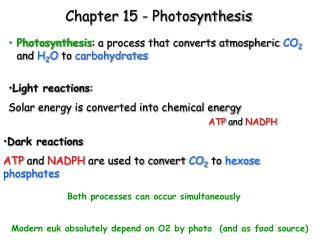
Photosynthesis is the biological process by which plants, algae, and some prokaryotes capture sunlight energy to convert carbon dioxide and water into glucose and oxygen. This process occurs in two main stages: light-dependent and light-independent reactions. Chloroplasts in plant cells contain pigments like chlorophyll, which absorb light energy to produce ATP and NADPH. The Calvin-Benson Cycle utilizes these energy carriers to synthesize glucose. Key adaptations of leaves enhance their efficiency in photosynthesis, including their structure and anatomy.

Understanding Photosynthesis: Processes, Structures, and Reactions
E N D
Presentation Transcript
What Is Photosynthesis? • The ability to capture sunlight energy and convert it to chemical energy. iStockphoto.com/hougaardmalan
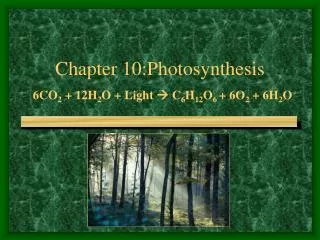
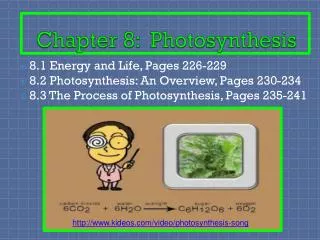
The Photosynthetic Equation 6CO2 carbon dioxide + 6H2O water + light energy sunlight C6H12O6 glucose (sugar) + 6O2 oxygen
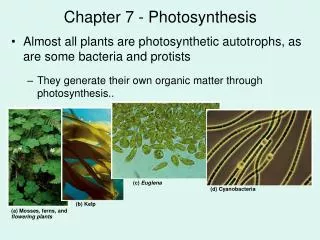
Photosynthetic Organisms • Plants, algae, and some prokaryotes • Are autotrophs (“self- feeders”) uni-bielefeld.de
Photosynthesis and Cellular Respiration • Are interconnected • Water, CO2, sugar, and O2are used or produced as byproducts in both processes
Adaptations for Photosynthesis • Leaves • Chloroplasts
Leaves • Flattened leaf shape exposes large surface area to catch sunlight • Epidermis • upper and lower leaf surfaces • Cuticle • waxy, waterproof outer surface • reduces water evaporation
Leaf Anatomy • Stomata • adjustable pores allow for entry of air with CO2 • Mesophyll • inner cell layers that contain majority of chloroplasts • Vascular bundles (veins) • supply water and minerals to the leaf while carrying sugars away from the leaf
Anatomy of a Chloroplast • Chloroplasts • bounded by a double membrane composed of innerand outer membranes • Stroma • semi-fluid medium within the inner membrane • Thylakoids • disk-shaped sacs found within the stroma • in stacks called grana
Location of Photosynthetic Reactions • 2 sets of chemical reactions occur in the: • Thylakoid membranes • Stroma
Light-dependent Reactions • Pigment molecules (e.g. chlorophyll) of the thylakoids capture sunlight energy • Sunlight energy is converted to the energy carrier molecules ATP and NADPH • Oxygen is released as a by-product
Light-independent Reactions • Enzymes in stroma synthesize glucose and other organic molecules using the chemical energy stored in ATP and NADPH
Light-Dependent Reactions • What two energy carrying molecules are used to store captured sunlight energy during light-dependent reactions?
The Energy in Visible Light • Sun radiates electromagnetic energy • Photons (basic unit of light) • packets of energy with different energy levels • short-wavelength photons are very energetic • longer-wavelength photons have lower energies • Visible light is radiation falling between 400-750 nanometers of wavelength
Light Captured by Pigments • Absorptionof certain wavelengths • light is “trapped” • Reflectionof certain wavelengths • light bounces back • Transmissionof certain wavelengths • light passes through
Light Captured by Pigments • Absorbed light drives biological processes when it is converted to chemical energy • Pigment absorbs visible light • Common pigments: • Chlorophyllaandb • absorb violet, blue, and red light but reflect green light (hence they appear green) • Carotenoids • absorb blue and green light but reflect yellow, orange, or red (hence they appear yellow-orange) • Are accessory pigments
Why Do Autumn Leaves Change Colors? autumn-pictures.com
Light-Dependent Reactions • Photosystems within thylakoids • Assemblies of proteins, chlorophyll, & accessory pigments • Two Photosystems • PSII (comes 1st) and PSI (comes 2nd) • Each Photosystem is associated with a chain of electron carriers
Light-Dependent Reactions Steps of the light reactions: • Accessory pigments in Photosystems absorb light and pass energy to reaction centerscontaining chlorophyll • Reaction centers receive energized electrons… • Energized electrons then passed down a series of electron carrier molecules (Electron Transport Chain) • Energy released from passed electrons used to synthesize ATP from ADP and phosphate • Energized electrons also used to makeNADPH from (NADP+) + (H+)
Maintaining Electron Flow • Electrons from PSII flow one-way into PS I • PSII – produces ATP • PSI – produces NADPH
Oxygen • May be used by plant or released into atmosphere
Light-Independent Reactions • NADPH and ATP from light-dependent rxns used to power glucose synthesis • Light not directlynecessary for light-independent rxns if ATP & NADPH available • Light-independent rxns called the Calvin-BensonCycle or C3 Cycle
The C3 Cycle • 6 CO2molecules used to synthesize 1 glucose (C6H12O6) • CO2is captured and linked to ribulose bisphosphate (RuBP) • ATP and NADPH from light dependent rxns used to power C3 reactions
Relationship Between Rxns • “Photo” • capture of light energy (light dependent rxns) • “Synthesis” • glucose synthesis (light-independent rxns) • Light dependent rxns produce ATP and NADPH which is used to drive light-independent rxns • Depleted carriers (ADP and NADP+) return to light-dependent rxns for recharging
The Ideal Leaf • The ideal leaf: • Large surface area to intercept sunlight • Very porous to allow for CO2 entry from air lowcarboneconomy.com biology-blog.com forestry.about.com sbs.utexas.edu
Leaves • Problem: • Substantial leaf porosity leads to substantial water evaporation, causing dehydration stress on the plant • Plants evolved waterproof coating and adjustable pores (stomata) for CO2 entry
When Stomata Are Closed • When stomata close, CO2 levels drop and O2 levels rise • Photorespiration occurs • Carbon fixing enzyme combines O2 instead of CO2 with RuBP
When Stomata Are Closed • Photorespiration: • O2 is used up as CO2 is generated • No useful cellular energy made • No glucose produced • Photorespiration is unproductive and wasteful
When Stomata Are Closed • Hot, dry weather causes stomata to stay closed • O2levels rise as CO levels fall inside leaf • Photorespiration very common under such conditions • Plants may die from lack of glucose synthesis
C4 Plants Reduce Photorespiration • “C4 plants” have chloroplasts in bundle sheath cells and mesophyll cells • Bundle sheath cells surround vascular bundles deep within mesophyll • C3plants lack bundle sheath cell chloroplasts
C4 Plants Reduce Photorespiration • C4 plants utilize the C4 pathway • Two-stage carbon fixation pathway • Takes CO2 to chloroplasts in bundle sheath cells
Environmental Conditions • C4 pathway uses up more energy than C3 pathway • C3 plants thrive where water is abundant or if light levels are low (cool, wet, and cloudy climates) • Ex. : most trees, wheat, oats, rice, Kentucky bluegrass • C4 plants thrive when light is abundant but water is scarce (deserts and hot climates) • Ex. : corn, sugarcane, sorghum, crabgrass, some thistles