Download
1 / 4
40 likes | 178 Views
This document outlines essential points for understanding the complexities of treaties related to renewable resource scarcity and their effects on conflict. It emphasizes the importance of supporting arguments with existing literature and citations, incorporating counterfactual analyses, and evaluating the difficulty of treaty outcomes. Additionally, it encourages a deep dive into the mechanisms behind treaties while utilizing feedback from previous assignments. Engaging with reference librarians can aid in further research, and drafts for review are welcomed to enhance final submissions.

E N D
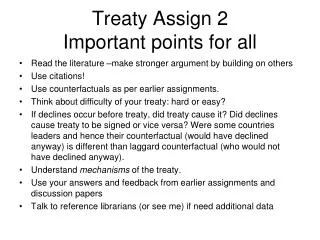
Treaty Assign 2Important points for all • Read the literature –make stronger argument by building on others • Use citations! • Use counterfactuals as per earlier assignments. • Think about difficulty of your treaty: hard or easy? • If declines occur before treaty, did treaty cause it? Did declines cause treaty to be signed or vice versa? Were some countries leaders and hence their counterfactual (would have declined anyway) is different than laggard counterfactual (who would not have declined anyway). • Understand mechanismsof the treaty. • Use your answers and feedback from earlier assignments and discussion papers • Talk to reference librarians (or see me) if need additional data
Treaty 3 • Give me a draft – I will read and respond to what you provide to help you do better on the final • Make sure to let me know if you are thinking about doing the presentation
Sources and Consequences of Renewable Resource Scarcity Homer-Dixon, Thomas F.; Boutwell, Jeffrey H.; Rathjens, George W. 1993. "Environmental change and violent conflict." Scientific American 268:2 (February), 38-45.
An Example from the Philippines Homer-Dixon, Thomas F.; Boutwell, Jeffrey H.; Rathjens, George W. 1993. "Environmental change and violent conflict." Scientific American 268:2 (February), 38-45.