Standard Model
Standard Model. Physicists have developed a theory called “The Standard Model” that explains what the world is and what holds it together. Standard Model. It was once thought that the fundamental particles were electrons, protons, neutrons.

Standard Model
E N D
Presentation Transcript
Standard Model Physicists have developed a theory called “The Standard Model” that explains what the world is and what holds it together.
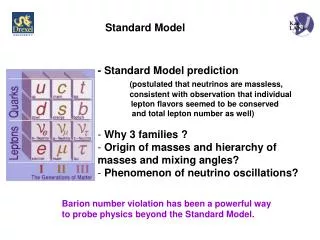
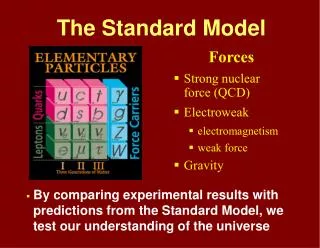
Standard Model • It was once thought that the fundamental particles were electrons, protons, neutrons. • Now we find smaller subatomic particles – quarks & leptons that comprise matter. • Forces are carried by particles too!
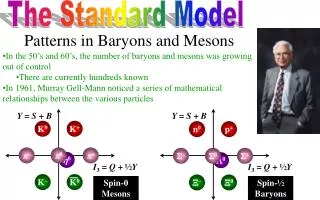
All matter either Hadrons or Leptons. p+ & no Quarks can’t exist alone.
Protons, Neutrons:baryons made of only up & down quarks. • How many up & down quarks in a p+? • Charge = +1 • Baryons have 3 quarks only. • 2 up & 1 down. • u + u + d • +2/3 +2/3 – 1/3 = +1
How many up & down quarks in a no? • Charge = 0 • 1 up & 2 down. • u d d • +2/3 -1/3 -1/3 = 0
Leptons • The most familiar member of this group is the electron e, but there are also heavier particles called the muon m and the tau t. • For each of those, there is a smaller “partner” called a neutrino n . • The leptons are all capable of independent existence.
All particles have anti-particles same mass. Antiparticles behave just like their corresponding matter particles, except they have opposite charges. A proton is electrically positive - an antiproton is negative. Gravity affects matter and antimatter the same way. When a matter & corresponding antimatter meet, they annihilate into pure energy!
A particle is composed of 2 charm, & 1 bottom quark. • Write the symbols & charges for all the particles. • Is it a meson, lepton or baryon? • c c b • +2/3 +2/3 -1/3 What is it’s charge? • +1. • Baryon.
A particle is composed of 1 anti-strange, & 1 down quark. • Write the symbols & charges for all the particles. • Is it a meson, lepton or baryon? • s d • +1/3 -1/3 What is it’s charge? • 0. • Meson.
Forces & Force Exchange Particles4 Fundamental Forces The universe exists because the fundamental particles interact. These interactions include 4 attractive & repulsive forces, decay, & annihilation. • Strong Nuclear (Nuclear) • Electromagnetic • Weak (Nuclear) • Gravity
Strong Force • Short Range, Attractive only – holds nuclear particles together. • Particle = gluons.
Electromagnetic Force • Long range. Attracts & repels charged particles (Coulomb’s Law). • Carrier particle = photon.
Weak Force • In the nucleus. Involved with decay of particles. Short range. The carrier particles of the weak interactions are the W+, W-, and the Z bosons.
Gravity • Long range weakest force. Attractive only. • The gravity force carrier particle has not been found. It, however, is predicted to exist and may someday be found: the graviton.
Quarks & Leptons 5:40 min.http://www.youtube.com/watch?v=aTFCKbZw8QY Hwk: Read Text 25-4 pg 917-923 Do pg 923 #1,2 Pg 928 #30 - 37
List 2 pieces of evidence that light is a wave. • Diffraction • Interference. List 1 piece of evidence that light is a stream of particles. • Photoelectric effect List 1 piece of evidence for the Bohr model of the atom. • Emission or Absorption spectra
The charge on an anti-up quark would be: • +1 • -1 • +2/3 • -2/3 Note: Antiparticles have a bar over the symbol.
This particle is a: • Lepton • Proton • Meson • neutron
Cern Standard Modelhttp://www.youtube.com/watch?v=V0KjXsGRvoA&feature=related5 minutes
Comprehensive Standard Model Summery(15 minutes)Cassiopeiahttp://www.youtube.com/watch?v=K6i-qE8AigE
Quantum Song • http://www.youtube.com/watch?feature=player_detailpage&v=DZGINaRUEkU
What is Higgs Boson 3:30 • http://www.youtube.com/watch?v=RIg1Vh7uPyw • What now for the Higgs 8:00 min w/ad. • http://www.youtube.com/watch?v=649iUqrOKuE