Exploring the Standard Model: The Fundamental Framework of Particle Physics
The Standard Model of particle physics serves as the fundamental framework for understanding the building blocks of matter and energy. It classifies all known particles, including leptons, quarks, and bosons, while exploring their interactions, properties, and behaviors. By organizing these particles into families, it elucidates concepts such as charge, spin, and the distinctions between matter and antimatter. This model also highlights mediating forces, including electromagnetic, weak, and strong forces, and delves into complex phenomena like Bose-Einstein condensates and particle annihilation.

Exploring the Standard Model: The Fundamental Framework of Particle Physics
E N D
Presentation Transcript
THE STANDARD MODEL • What’s fundamental • What’s in a name
Organizational table(s) • Periodic table • Organizes atoms by properties • Reading the table • Atoms and even nuclei are not fundamental • Scale of subatomic matter (see illustration next slide)
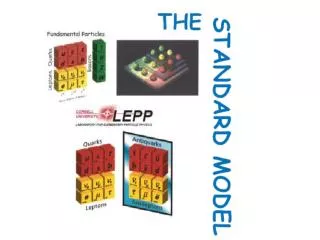
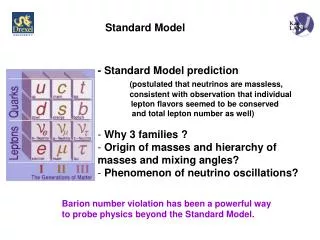
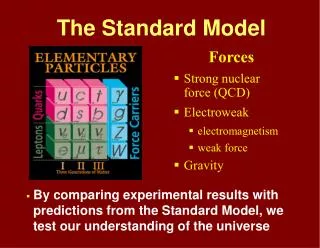
Standard model chart • Organizes all of matter and energy (well most of it) • Matter Vs. Antimatter • Charge • Annihilation • Pair production
Bosons Vs. Fermions • Spin
Fermion Flavors • Leptons and Quarks
Leptons • Solitary particles • Charge on particles Vs. antiparticles • Generations or Families
Leptons • Lepton family conservation • Neutrino’s and conservation laws
Quarks • Generations or families • Charge • Combinations • Particles Vs. antiparticles
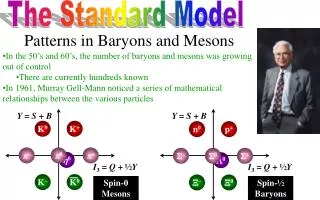
Combinations of quarks – Hadrons • Baryons • Examples of Baryon particles • Spin and consequences
Combinations of quarks - Hadrons • Mesons • Examples of Mesons • Spin and consequences (see illustration)
Bosons (single particles) • Spin (got it yet?) • Mediate forces (Fields Vs. exchange particles) • Electromagnetic • Weak • Electroweak • Strong • Gravity