Advancing Water Management Finance: Insights and Strategies for Effective Investment
10 likes | 116 Views
This report outlines our team's pioneering approach to reshaping finance policy for integrated water management (IWM). We achieved consensus among diverse stakeholders, establishing shared values and prioritizing investment strategies. Our analysis revealed critical challenges, including outdated funding constructs and inconsistent finance data, leading to recalibrated discussions on the scope of IWM. Lessons learned emphasize the importance of understanding stakeholder values and the need for innovative funding strategies beyond traditional methods. Together, we are proud to have crafted a forward-thinking finance policy for sustainable water management.


Advancing Water Management Finance: Insights and Strategies for Effective Investment
E N D
Presentation Transcript
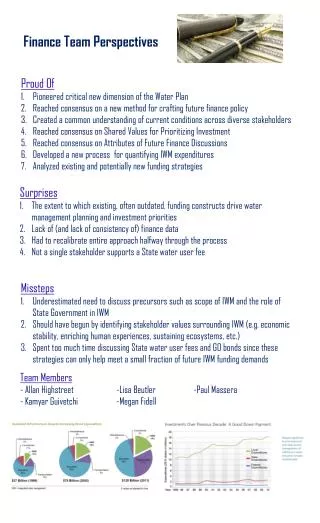
Finance Team Perspectives • Proud Of • Pioneered critical new dimension of the Water Plan • Reached consensus on a new method for crafting future finance policy • Created a common understanding of current conditions across diverse stakeholders • Reached consensus on Shared Values for Prioritizing Investment • Reached consensus on Attributes of Future Finance Discussions • Developed a new process for quantifying IWM expenditures • Analyzed existing and potentially new funding strategies • Surprises • The extent to which existing, often outdated, funding constructs drive water management planning and investment priorities • Lack of (and lack of consistency of) finance data • Had to recalibrate entire approach halfway through the process • Not a single stakeholder supports a State water user fee • Missteps • Underestimated need to discuss precursors such as scope of IWM and the role of State Government in IWM • Should have begun by identifying stakeholder values surrounding IWM (e.g. economic stability, enriching human experiences, sustaining ecosystems, etc.) • Spent too much time discussing State water user fees and GO bonds since these strategies can only help meet a small fraction of future IWM funding demands Team Members- Allan Highstreet-Lisa Beutler -Paul Massera - KamyarGuivetchi-Megan Fidell