Download
1 / 8
80 likes | 220 Views
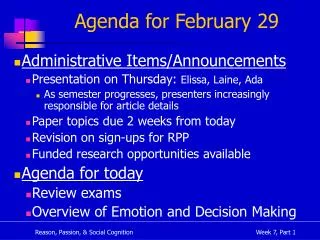
Agenda for February 8. Administrative Items/Announcements Attendance 2nd Presentation This Thursday 1 st Exam next week Paper Assignment Distributed on Tuesday, 2/15 Feedback Exercise (quiz) Continuation of 1 st Presentation Are Cognition and Emotion Separate Systems?

E N D
Agenda for February 8 • Administrative Items/Announcements • Attendance • 2nd Presentation This Thursday • 1st Exam next week • Paper Assignment Distributed on Tuesday, 2/15 • Feedback Exercise (quiz) • Continuation of 1st Presentation • Are Cognition and Emotion Separate Systems? • Today’s topic: Emotional Lability Week 4, Part 1
Feedback Exercise Part I. Schachter & Singer (1962) posit two necessary conditions for the experience of emotion. What are they? Part II. Are emotions contagious? Why or why not? (Draw on today’s readings to inform your response.) Week 4, Part 1
Continuation of 1st Presentation Week 4, Part 1
Emotional Lability Schacter & Singer (1962) • Hypotheses: • Euphoria Pattern: Epi Mis > Epi Ign > Epi Inf = Placebo • Anger Pattern: Epi Ign > Epi Inf = Placebo Week 4, Part 1
Emotional Lability, cont. • Design: 3 x 2 3 Drug (Epinephrine informed, Epi. Ignorant, Placebo) X 2 Confederate Emotion (Anger, Euphoria) Plus offset Epi. Misinformed within Euphoria • Primary DV’s • Emotional state (behavior and self report) Week 4, Part 1
Emotional Lability, cont. Schacter & Singer (1962) • Results: • Mood: Ss in Epi. Ign. and Epi. Mis. were more susceptible to stooge’s euphoria • Behavior: Ss in in Epi. Mis. were more likely to behave euphorically than ss in Epi. Mis. Ss in Epi. Ign. more likely to act angrily than ss in Epi. Inf. Or in placebo. • Discussion: • Any problems with the study? Week 4, Part 1
Problems with the Schachter & Singer Study • Experimental confound in the anger manipulation (questionnaire) • Comparison of self-reported euphoria (Table 2) not significantly different between placebo and Epi. Mis or Epi. Ign. • Only behavioral data for anger. Ss unwilling to act angry if it jeopardized extra-credit points? Week 4, Part 1
Problems with the Schachter & Singer Study • The shot caused placebo subjects to “get the shivers,” potentially obscuring epinephrine effects. • S & S cannot, therefore, test their idea that “subjects will only reaction emotionally to the extent that they experience physiological arousal. Week 4, Part 1