Download
1 / 9
110 likes | 247 Views
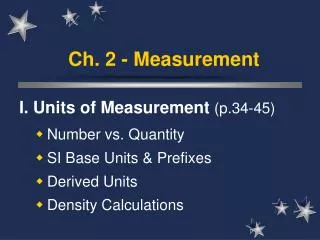
This resource provides a comprehensive overview of measurement units, focusing on the International System of Units (SI). It distinguishes between quantity and number, detailing base units such as length (meter), mass (kilogram), time (second), temperature (kelvin), and amount (mole). It further explores derived units like volume and density, including practical examples of problem-solving steps for calculating density. Get insights into how to compute mass from volume and density, with explicit formulas and sample problems for better understanding.

E N D
CH. 5 - MEASUREMENT II. Units of Measurement
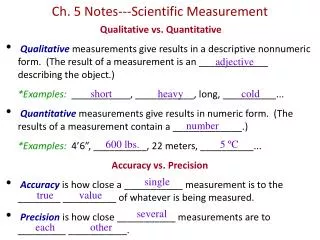
A. Number vs. Quantity • Quantity - number + unit UNITS MATTER!!
B. SI Units Quantity Symbol Base Unit Abbrev. Length l meter m Mass m kilogram kg Time t second s Temp T kelvin K Amount n mole mol
mega- kilo- k M 106 103 BASE UNIT deci- --- d 100 10-1 centi- c 10-2 milli- m 10-3 micro- 10-6 nano- n 10-9 pico- p 10-12 B. SI Units Prefix Symbol Factor
M V D = C. Derived Units • Combination of base units. • Volume (m3 or cm3) • length length length 1 cm3 = 1 mL 1 dm3 = 1 L • Density (kg/m3 or g/cm3) • mass per volume
D. Density Mass (g) Volume (cm3)
Problem-Solving Steps 1. Analyze 2. Plan 3. Compute 4. Evaluate
D. Density • An object has a volume of 825 cm3 and a density of 13.6 g/cm3. Find its mass. GIVEN: V = 825 cm3 D = 13.6 g/cm3 M = ? WORK: M = DV M = (13.6 g/cm3)(825cm3) M = 11,200 g
WORK: V = M D V = 25 g 0.87 g/mL D. Density • A liquid has a density of 0.87 g/mL. What volume is occupied by 25 g of the liquid? GIVEN: D = 0.87 g/mL V = ? M = 25 g V = 29 mL